Pricing checked 17 Nov 2026.
A failed payment is two events: a billing event the platform retries, and a support ticket someone has to answer. This comparison of the best subscription billing platforms covers both, including the half every other roundup skips.
TL;DR: Recurly Research finds 7.2% of subscribers are at risk of involuntary churn each month, yet most billing platforms only let support view the account. Choose one where an agent can credit, pause or refund without a developer.
- Recurly: best for support teams working in Zendesk
- Stripe Billing: best if you already process payments on Stripe
- Chargebee: best for scaling SaaS with a complex catalog
- Paddle: best for handing billing support to a merchant of record
- Orb: best for usage-based and AI pricing
- Dodo Payments: best for small digital sellers who want pay-on-recovery dunning
Methodology & sources
- Three established platforms and three smaller challengers, scored on five criteria: billing models, dunning, whether a non-developer can issue a credit or grace period, helpdesk connectivity, published pricing. The support criterion is one of five.
- Prices and features come from each vendor's pricing page and documentation, read 17 Nov 2026, in USD. No published price means "quote only", not an estimate.
- Churn figures: Recurly Research (1,200 businesses, four months) and a Forrester study commissioned by Recurly. Recovery rates are vendor-claimed.
- Disclosure: this is Aissist's blog. Aissist sells AI agents that resolve support tickets, billing ones included. It is not a billing platform and is not ranked.
What is a subscription billing platform?
A subscription billing platform charges customers on a schedule, retries failed payments, and records every invoice, credit and cancellation.
Dunning is the part that chases failed payments: retries, reminder emails, and eventually cancellation. Recurly estimates that involuntary churn accounts for 20–40% of all churn, and it projected failed payments would cost subscription businesses $129 billion in 2025. In a Forrester study commissioned by Recurly, 59% of businesses said they lack the tools to tackle it.
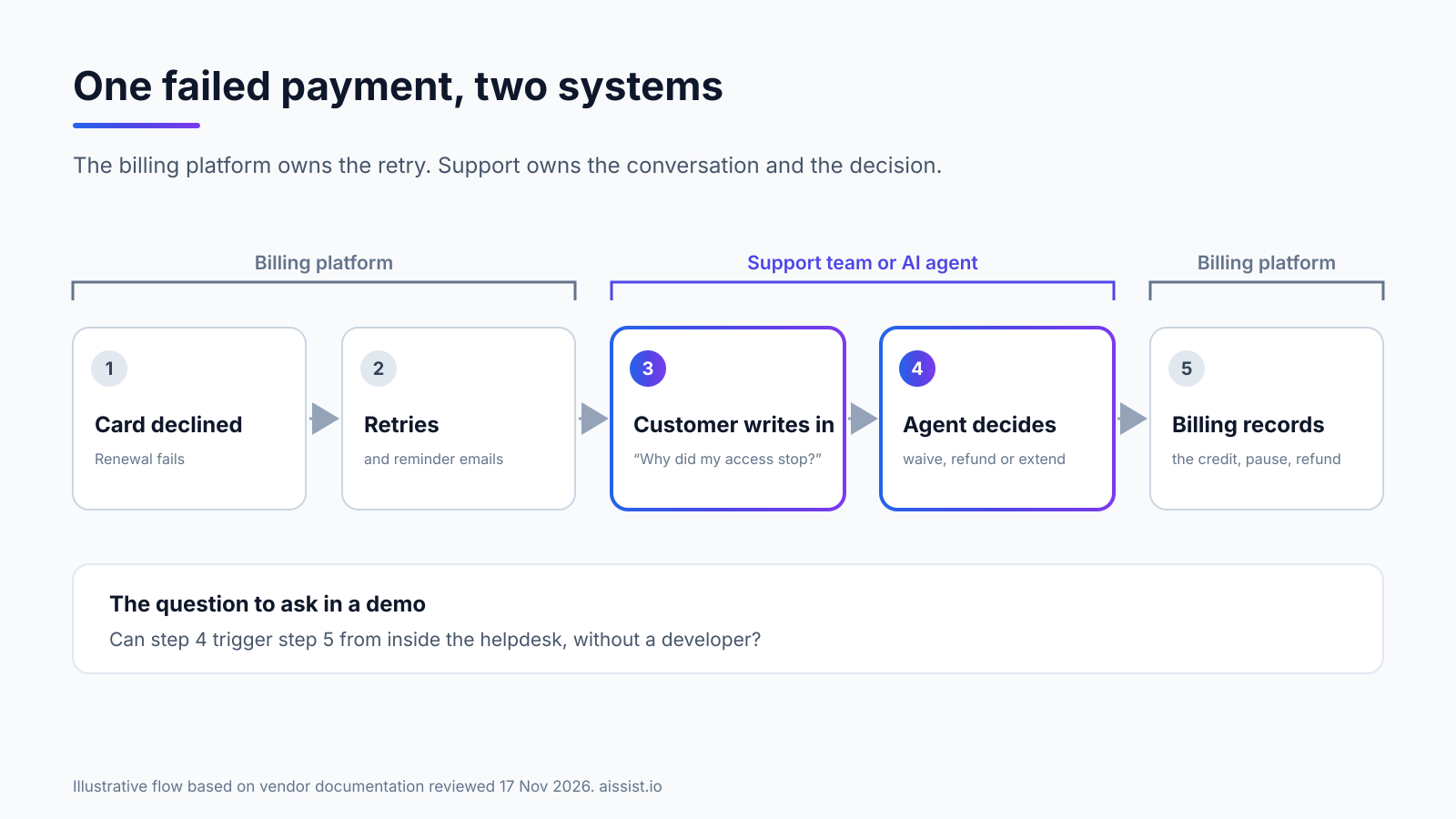
The platform owns the retry. It does not own the reply when the customer writes in asking why their access stopped.
"This can be very embarrassing." — Darryl Hicks, Founder and CEO, FlexPay, speaking to PYMNTS about telling customers their card was declined for insufficient funds
That is the support problem in five words. The customer feels it, and the agent has to handle it.
How do the 6 platforms compare?
The six platforms split on two things: how they charge you, and whether a support agent can apply a remedy without code. Billing models and dunning are close to table stakes; the price model and the fourth column are where they differ.
| Platform | Billing models | Dunning sequences | Can support issue a credit or grace period without code? | Webhook to the helpdesk | Published price (Nov 2026) | Free tier |
|---|---|---|---|---|---|---|
| Recurly | Recurring, usage | 1 campaign on Starter; multiple on All-Access | Yes, from inside Zendesk (pause, cancel, refund) | Native Zendesk Support and Chat apps | Starter $249/mo + 0.9%, first $40K/mo included | 90-day trial |
| Stripe Billing | Recurring, usage, hybrid | Smart Retries, reminder emails, up to 3 recovery automations | Yes: pause payment collection, credit notes in Dashboard | Webhooks; Intercom app; Intercom Fin can refund | 0.7% of billing volume, or $620/mo + 0.67% | No monthly fee |
| Chargebee | Recurring, usage, hybrid | Basic and Smart dunning | Yes, in the Chargebee app only | Zendesk, Freshdesk, Intercom apps (view-only) | Flow 0.80%, or $99/mo + 0.65% | None |
| Paddle | Recurring, one-time | Paddle Retain | Pause and refund in dashboard; most refunds need Paddle approval | Webhooks; Paddle answers buyer billing queries | 5% + 50¢ per transaction | No monthly fee |
| Orb | Usage, credits, hybrid | Default; custom sequences on Enterprise | Credit notes and credit grants in dashboard | Webhooks | $6.00 per credit; Enterprise quote | 100 free credits |
| Dodo Payments | Recurring, usage, add-ons | Retries and dunning, 5% of recovered amount | Pause and resume in dashboard | Webhooks | 4% + 40¢, +0.5% on subscriptions | No monthly fee |
Stripe Billing's fee sits on top of Stripe's 2.9% + 30¢ card fee; Paddle and Dodo include processing because they act as merchant of record. Chargebee retired its free Starter plan in August 2026, according to UsagePricing's tracker.
Read the fourth column twice. It is the one your support team lives in.
Where each one falls short:
- Recurly: Starter carries a $249 base fee and a single dunning campaign.
- Stripe Billing: the 0.7% stacks on card fees, and in-helpdesk refunds depend on Intercom.
- Chargebee: helpdesk apps are view-only, and the free tier is gone.
- Paddle: 5% + 50¢ bites on low-priced products, and most refunds wait for Paddle's approval.
- Orb: custom dunning sequences are Enterprise-only.
- Dodo Payments: recovered revenue carries a 5% fee on top of transaction fees.
What are the five billing tickets your support team gets most?
Five billing tickets show up in nearly every subscription queue, and the billing system closes only one of them alone. The other four need a decision first, then an action the billing system records.
| Ticket | What caused it | Who must resolve it | The remedy |
|---|---|---|---|
| "My card was declined" | Failed renewal | Billing retries; support reassures and sends the update link | Payment-update link, or pause collection |
| "Why was I charged twice?" | Duplicate subscription or retry after manual payment | Support decides; billing executes | Refund or credit note |
| "I cancelled and you billed me anyway" | Cancellation timed to term end | Support decides; billing executes | Refund, immediate cancel |
| "Can I have a few more days?" | Dunning deadline | Support decides; billing records | Grace period |
| "I need a proper invoice" | Missing tax ID | Billing, or the merchant of record | Reissued invoice |
Stripe's documentation is candid: pausing collection "is sometimes called a grace period." It is a billing setting and a support decision.
"Subscriber churn is the enemy of every brand we speak to." — Jonas Flodh, CPO, Recurly, via Electronic Payments International
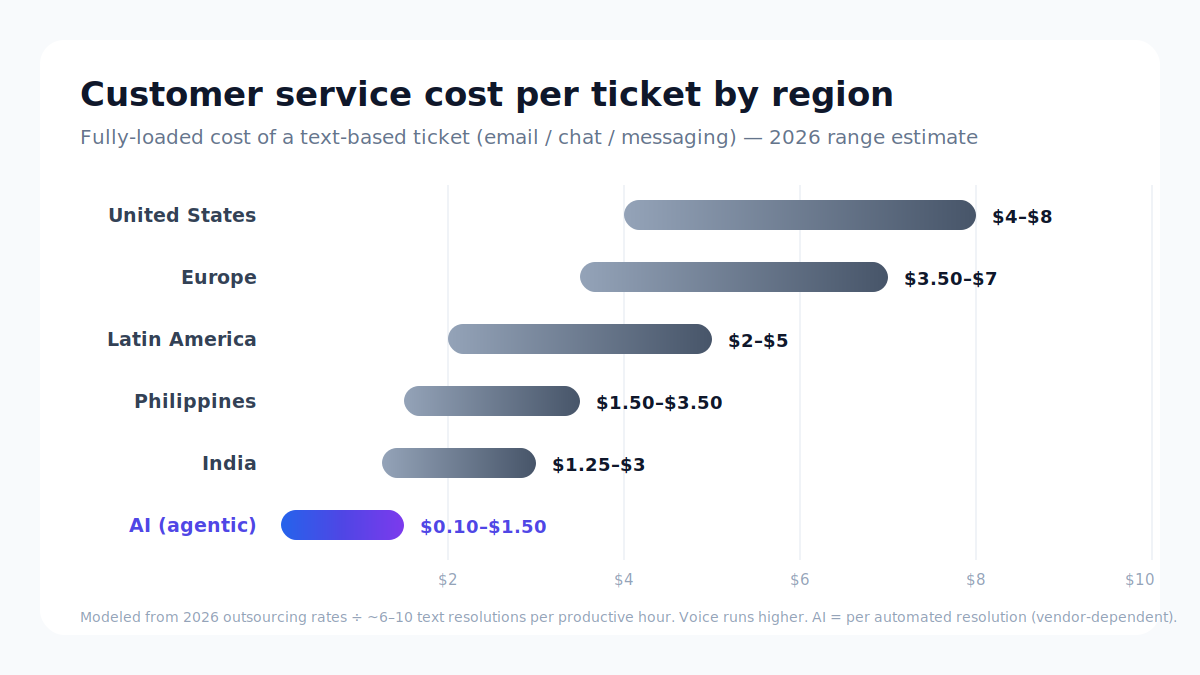
Every ticket that waits on a developer is handled twice, which is how cost per ticket quietly doubles.
Which billing platforms let support fix the problem without a developer?
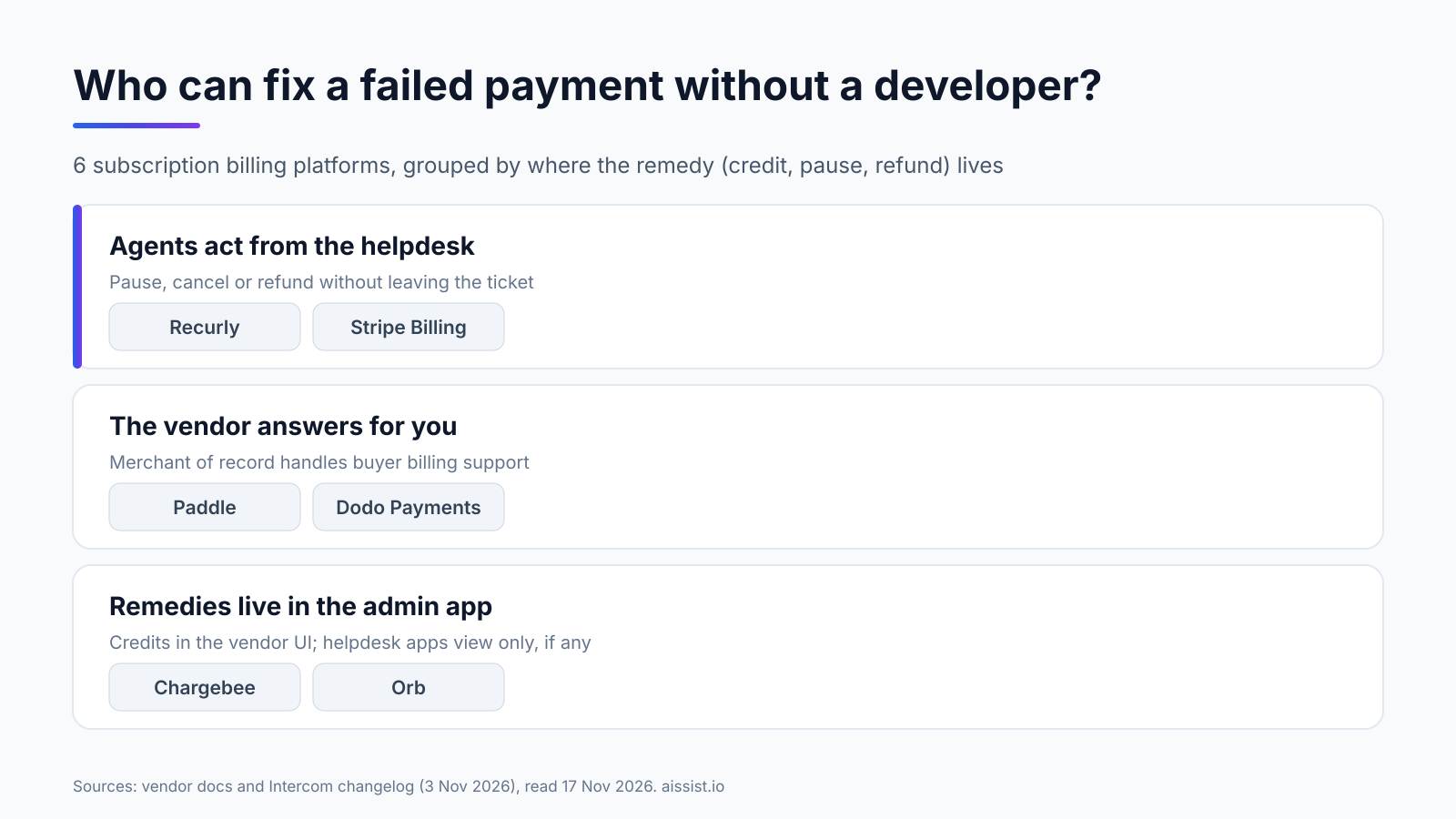
Recurly and Stripe let agents act from the helpdesk, Paddle and Dodo answer billing queries for you, and Chargebee and Orb keep remedies in their admin app.
Agents act from the helpdesk. Recurly's Zendesk app lets agents pause, cancel and refund on all plans. Stripe connects through Intercom; since Intercom's 3 Nov 2026 update, its Fin agent can pause, resume or cancel in Stripe, Chargebee, Paddle and Recurly, but refunds and plan changes only in Stripe.
"The best part is, no developer resources were required." — Maggie Mann, Program Manager of E-Commerce, Wyze, on Recurly's Zendesk integration
The vendor answers for you. Paddle runs 24/7 billing support for your buyers; Dodo processes refunds on merchants' behalf. The trade-off is control: Paddle must approve most refunds.
Remedies live in the admin app. Chargebee and Orb let a trained user issue credits in their UI. Chargebee's Zendesk plugin displays subscription details; it does not act on them. Tabbing across is fine at 20 tickets a week. At 2,000 it is a job title.
A platform that can retry a card but cannot let an agent extend a grace period has moved the work, not removed it.
How should you choose a billing and dunning platform?
Choose on where your support team works, then on price, because the remedy has to reach the agent.
- If agents live in Zendesk, choose Recurly, because its app acts inside the ticket on every plan.
- If you process on Stripe, choose Stripe Billing, because pause and credit notes need no code and Fin can refund.
- If you'd rather not run billing support or sales tax, choose Paddle or Dodo Payments, because the merchant of record answers buyers, at 5% + 50¢ or 4% + 40¢ per transaction.
- If you price on usage or credits, choose Orb, because credit grants and credit notes sit in its dashboard.
- If your catalog is complex and finance owns billing, choose Chargebee, because it handles hybrid pricing and retention flows, as long as agents accept tabbing into its app.
Billing sits next to the payment stack, so pair this with our guides to payment orchestration, chargeback management and e-commerce fraud prevention.
Dunning is a support workflow that happens to start in billing
The retry is the easy half. Every platform here retries cards competently, and most send decent emails. The hard half is the customer who replies, and that conversation ends in a credit, a pause or a refund the billing system has to accept from someone who isn't a developer.
So test the fourth column in a demo: ask the vendor to extend a grace period from inside your helpdesk. If it can't, budget for the tab-switching, or for an AI agent for e-commerce that can take that action in the conversation itself.
Frequently asked questions
What is dunning in subscription billing?
Dunning is the automated process of recovering failed subscription payments through card retries, reminder emails and, eventually, cancellation. Most billing platforms include it; the difference is how configurable the sequence is.
What is the cheapest subscription billing platform?
At low volume, Stripe Billing's 0.7% with no monthly fee is the lowest published entry price here, before card processing. Chargebee Flow charges 0.80%, or $99 a month plus 0.65%.
Does Chargebee still have a free plan?
No. Chargebee replaced its free Starter plan with the Flow plan in August 2026, priced at 0.80% of monthly billing value with no platform fee.
Can an AI agent handle failed-payment tickets?
Yes, if it is connected to the billing system with permission to act. Intercom's Fin can pause, resume or cancel subscriptions in Stripe, Chargebee, Paddle and Recurly as of November 2026.
What is the difference between a billing platform and a merchant of record?
A billing platform runs subscriptions while you remain the legal seller. A merchant of record, such as Paddle or Dodo Payments, sells on your behalf and handles sales tax, refunds and buyer billing support.