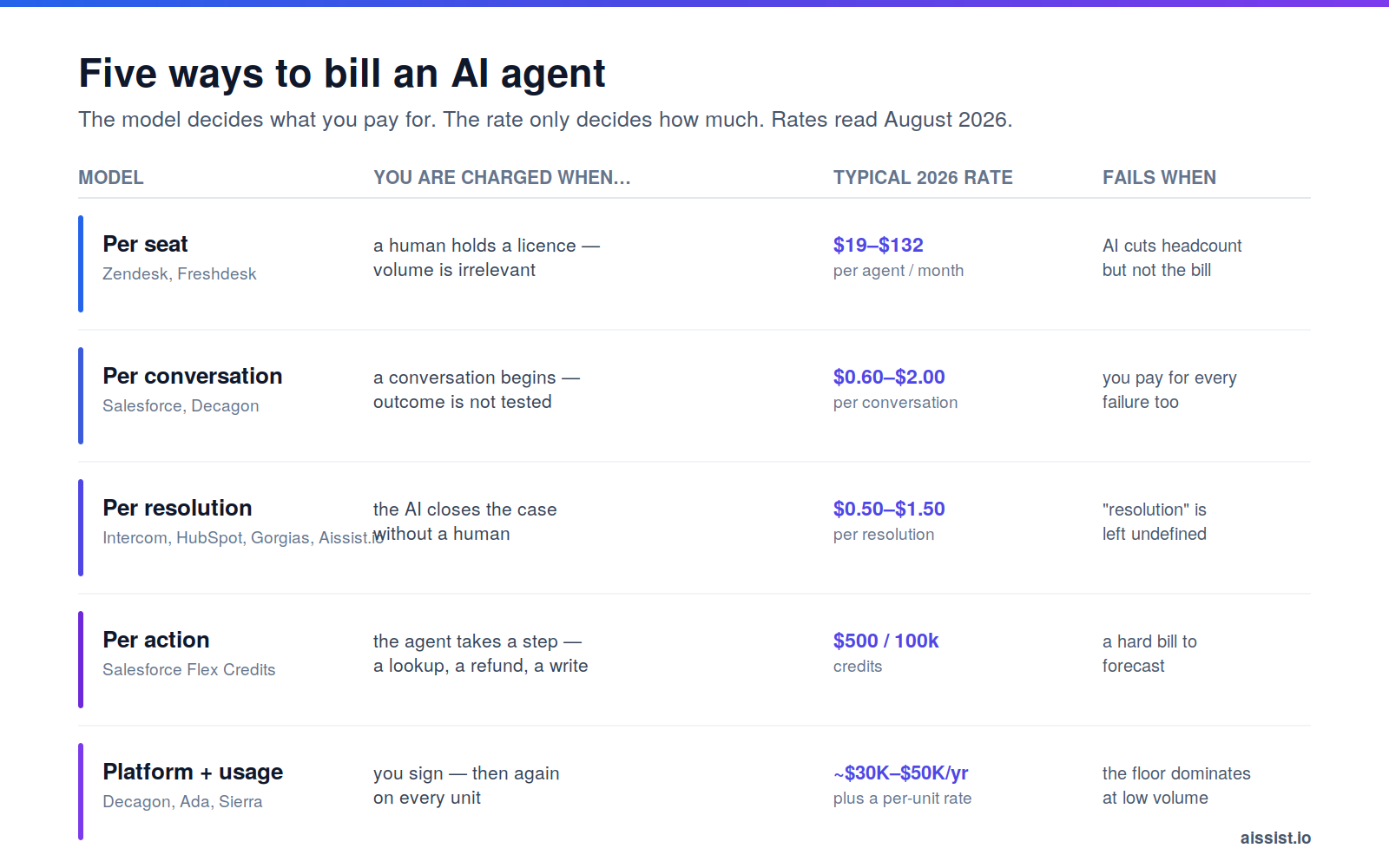
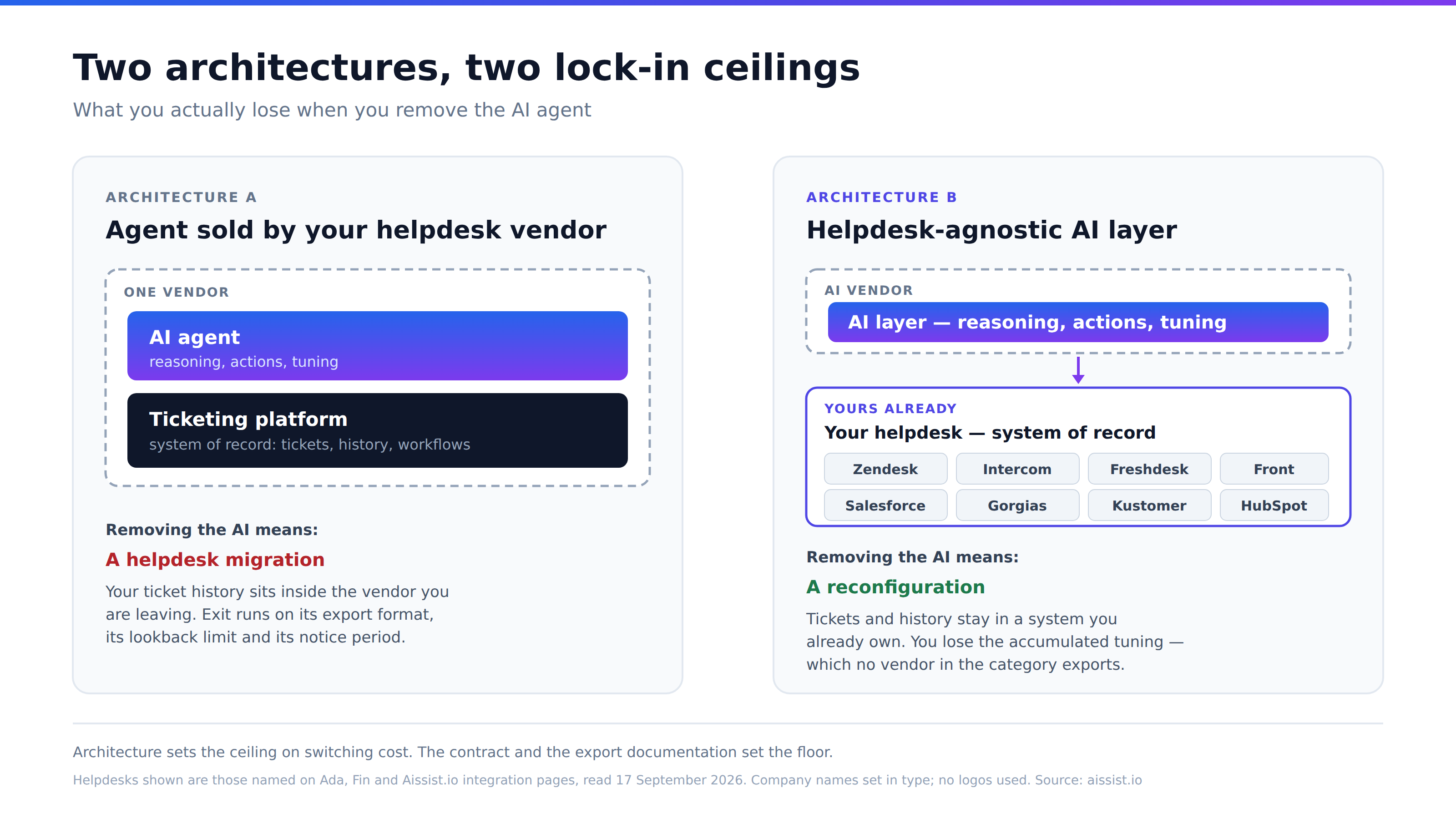
On 17 November 2026, Genesys announced Standalone AI Agents, which deploy its agentic virtual agent without migrating to Genesys Cloud, and renamed AI Tokens as effort-priced Experience Units. Here is what it proves, and how to judge Genesys AI agents alternatives.
TL;DR: The Genesys release confirms AI resolution now sells apart from the contact center, but "standalone" covers the deployment boundary, not the data boundary, and its effort tiers have no published rate.
Methodology & sources
- Launch details: Genesys release (17 Nov 2026) and eCommerceNews (18 Nov 2026).
- Prices: Intercom, Zendesk and Aissist.io pricing pages, verified November 2026.
- Disclosure: this is Aissist's blog; Aissist sells a competing AI agent.
What are Genesys Standalone AI Agents?
Genesys Standalone AI Agents are customer service AI agents that deploy Genesys Cloud's Agentic Virtual Agent without migrating the contact center to Genesys Cloud. They are generally available now; companion launch Genesys Arena offers prebuilt Agent Kits.
| Claim | What Genesys announced | What to verify in a demo |
|---|---|---|
| No migration | Deploys without first moving your environment to Genesys Cloud | Which helpdesks and CRMs it reads from and writes to |
| Speed | Production in a few days | Days to first live resolution on your data |
| Handoff | Passes the conversation and context to an employee | Whether the handoff lands in your desk as a ticket |
| Arena kits | 50+ use cases; an agent in as little as 10 minutes | Kits deploy directly to Genesys Cloud; ask what runs outside it |
Credit where due: an incumbent unbundling its own AI proves buyers want resolution without a re-platform.
"Enterprises want to move faster with AI, but they need the flexibility to do it on their own terms…" — Tony Bates, Chairman and CEO, Genesys
Is "standalone" the same as an AI overlay?
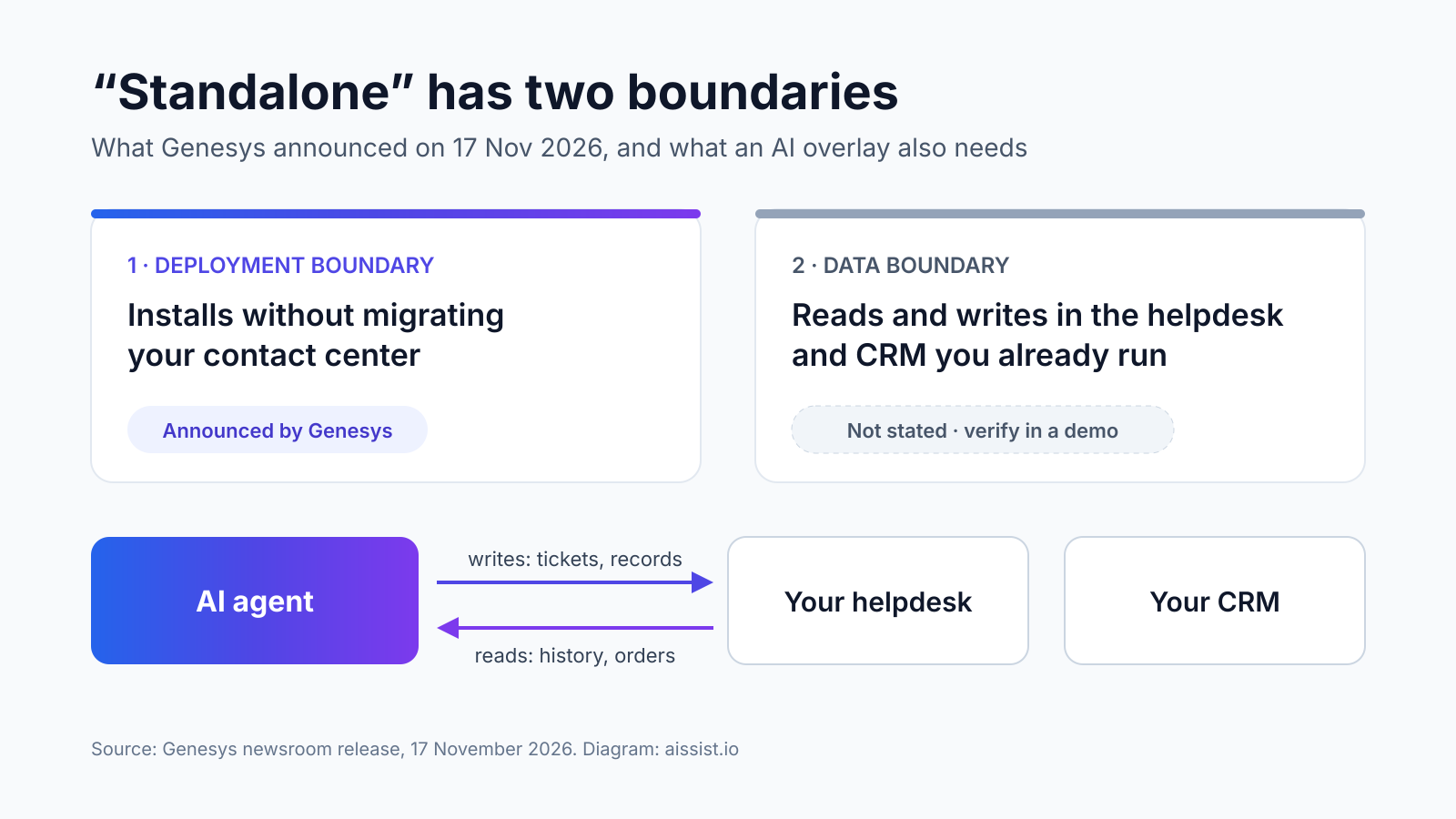
No: standalone at the deployment boundary means it installs without a migration, while standalone at the data boundary means it reads and writes in the helpdesk and CRM you already run. The Genesys release documents the first, not the second.
An overlay is only as useful as its write access. An AI that approves a refund but cannot close the ticket in Zendesk has created a second system of record. Adding AI to Zendesk without replacing the stack depends on that write path.
Salesforce and ServiceNow committed $1.5 billion to Genesys in July 2025, earmarked, TechTarget reported, for integrations with their own platforms.
"[ServiceNow and Salesforce] understand that, ultimately, whoever owns orchestration gets to make a lot of calls…" — Rebecca Wettemann, founder, Valoir, via TechTarget
That doesn't make the product worse; it shows whose stack the budget serves.
What four questions does a standalone AI agent have to answer?
A standalone AI agent has to prove it writes back, keeps your record, lets you leave and serves your roadmap. Ask every vendor, us included:
- Does it write back into my helpdesk? Resolved cases should close as tickets in your desk, not in a parallel console.
- Who owns the conversation record? The transcript should live in your desk or CRM, not just vendor analytics.
- What happens to my data if I leave? Get the export format in writing. Our own vendor lock-in scorecard found three of seven vendors, Aissist.io included, publish no readable export path, so hold us to this one too.
- Is the roadmap serving my stack or theirs? Ask which helpdesk integrations shipped last quarter.
In a customer story, Game Room Shop runs Aissist.io's AI operational layer on Gorgias, with presales answers drawn from live Shopify data. That is the data boundary in practice. Installing without a migration is table stakes. Writing back without one is the product.
How does Genesys Experience Units pricing compare with the alternatives?
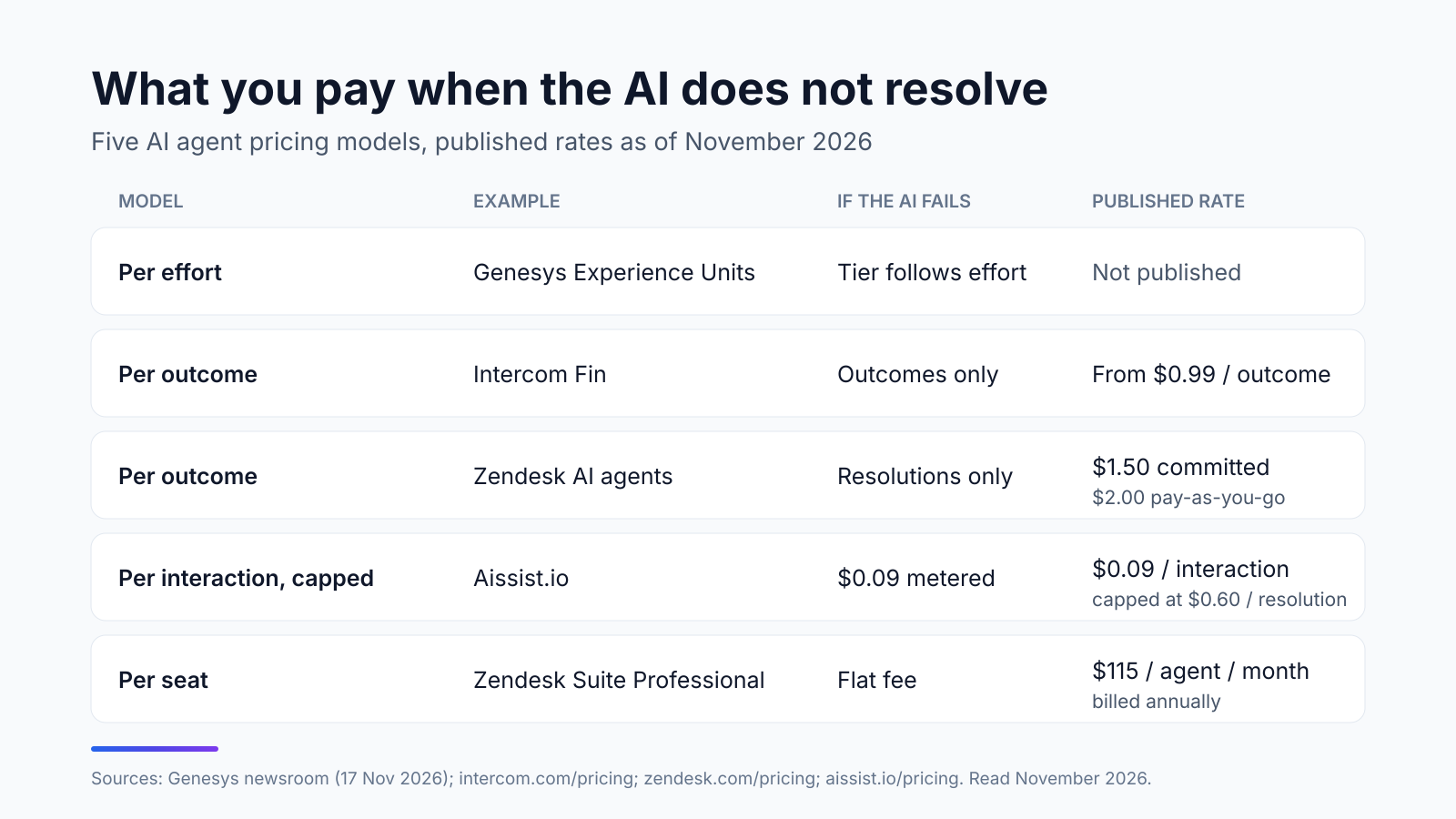
Genesys Experience Units count each interaction once at a simple, moderate or complex tier, set by the tools it needs; no rates are published. Because the tier follows effort, not outcome, ask whether a complex interaction that ends with a human still bills as complex — the question most AI agent pricing models differ on.
| Model | Example | Unit | Charged when the AI fails? | Published rate (Nov 2026) |
|---|---|---|---|---|
| Per effort | Genesys Experience Units | Interaction, tiered by tools used | Tier follows effort, not outcome — confirm | Not published |
| Per outcome | Intercom Fin | Fin outcome | Outcomes only | From $0.99 per outcome |
| Per outcome | Zendesk AI agents | Automated resolution | Resolutions only | $1.50 committed; $2.00 pay-as-you-go |
| Per interaction, capped | Aissist.io | AI interaction | Yes, metered | $0.09 per interaction; $0.60 cap per resolution |
| Per seat | Zendesk Suite Professional | Agent seat per month | Yes, flat | $115, billed annually |
Aissist.io caps each case at $0.60, so a failed conversation costs cents, not a tier; Aissist reports 83% average resolution and 4.8/5.0 CSAT on its AI customer service benchmark. Until Genesys publishes a rate card, the cheapest tier is the one you negotiate.
Genesys proved the category; write-back decides the vendor
Genesys unbundling its AI agents validates the AI operational layer model. The buying question is no longer whether an agent installs without migration, but whether it writes into your desk, keeps your record, lets you leave and bills fairly on failure. Run the four questions, then the price comparison tool.
Frequently asked questions
What are the best alternatives to Genesys AI agents?
Helpdesk-native agents such as Intercom Fin and Zendesk AI agents, and helpdesk-agnostic overlays such as Aissist.io, which deploy onto Zendesk, Freshdesk or Intercom.
How much do Genesys Experience Units cost?
Genesys has not published Experience Unit rates. Its 17 November 2026 release says each interaction is counted once and tiered as simple, moderate or complex.
Do Genesys Standalone AI Agents require Genesys Cloud?
No migration to Genesys Cloud is required to deploy them, according to Genesys. The same release says Arena Agent Kits deploy directly to Genesys Cloud.
Can I add AI to my contact center without migrating?
Yes. Genesys Standalone AI Agents and overlays such as Aissist.io both deploy without migration; what differs is whether they write back into your existing helpdesk and CRM.