Compiled by Lucía Díaz. Published November 17, 2026 · Prices and pages checked November 17, 2026.
Every ranking of the best transaction monitoring software compares detection. This one also asks what happens next, because a frozen transfer is a compliance decision and a support conversation at the same time.
TL;DR: Detection is converging, but a platform that alerts on 2% of a million transactions still produces about 19,000 false-positive holds a month if PwC's 90–95% range holds — and none of the six vendors below publishes how those cases reach support.
The shortlist
- Unit21 — best for US fintechs that want AI agents working the alert queue
- SEON — best for teams running fraud and AML in one rules engine
- ComplyAdvantage — best for sanctions and PEP data depth
- Tookitaki — best for APAC banks and payment firms
- Fraud.net — best for a published, usage-based price
- Facctum — best for payment screening alongside monitoring
How we compared these platforms
- Six criteria: detection approach, sanctions and PEP coverage, published false-positive handling, case-management hand-off to support, published price, deployment.
- Sources: each vendor's product and pricing pages, AWS Marketplace, Capterra/GetApp listings, the US agencies' joint statement on SAR confidentiality and UK legislation. All read November 2026.
- Every false-positive figure below is vendor-claimed unless stated otherwise.
- "No native helpdesk app found" means we searched the Zendesk Marketplace and vendor integration pages and found none built by the vendor.
- Disclosure: this is Aissist's blog. Aissist sells AI support agents, not transaction monitoring, and no vendor paid for placement. Nothing here is legal advice.
What is transaction monitoring software?
Transaction monitoring software screens customer payments against rules, models and watchlists, then raises alerts on activity that may signal money laundering, fraud or sanctions breaches.
In a fintech, that alert usually becomes a hold, a request for documents or a delayed withdrawal. The compliance team owns the decision. The support team owns the customer who notices. If you are still choosing an onboarding stack, start with our guide to the best KYC providers; monitoring is what watches those customers afterwards.
How many support conversations does a monitoring system create?
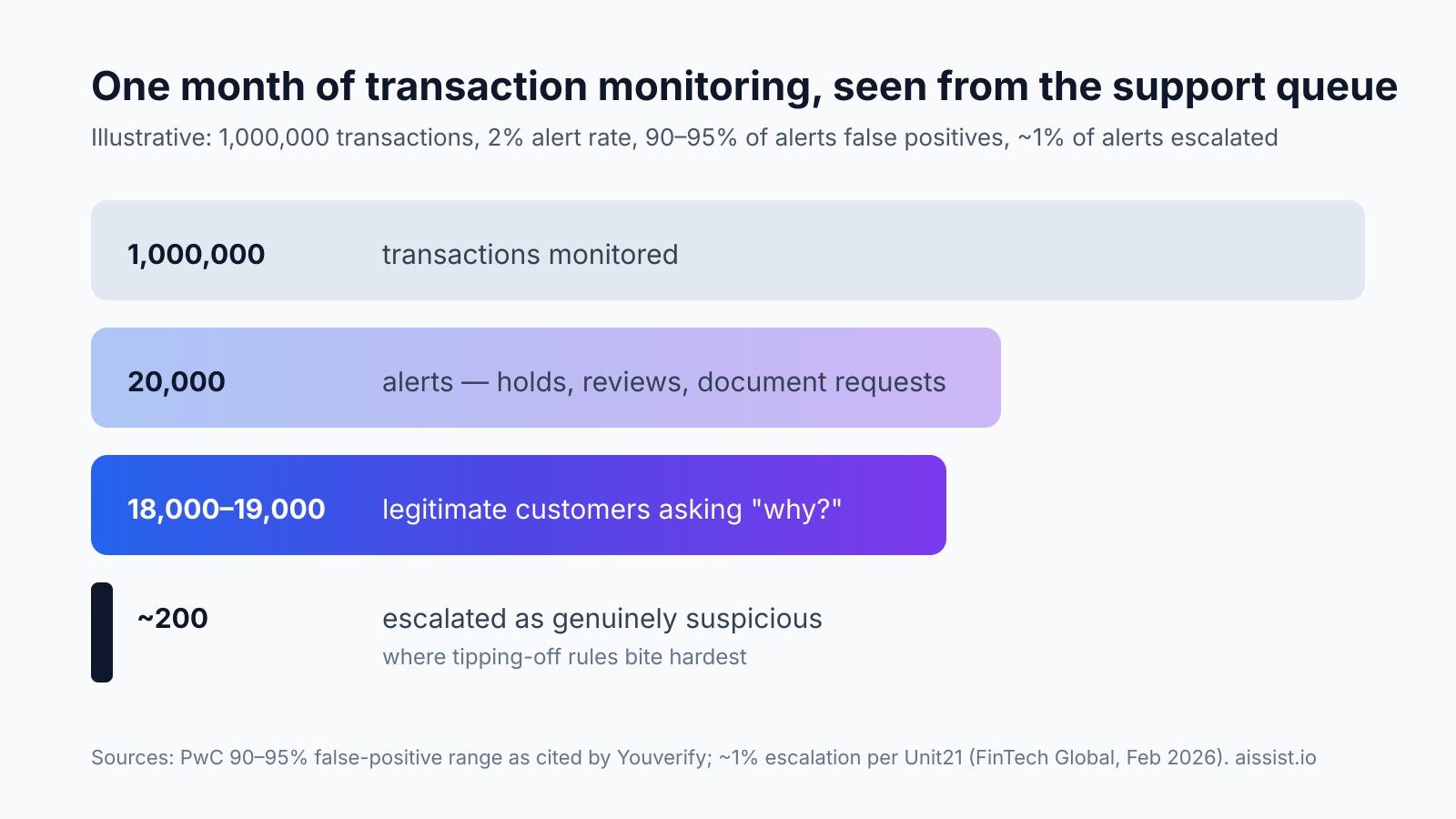
Far more than it creates suspicious-activity cases: at a 2% alert rate on a million monthly transactions, roughly 18,000–19,000 of the 20,000 alerts land on legitimate customers.
The arithmetic is simple. Youverify cites PwC research putting false positives at 90–95% of transaction monitoring alerts. Unit21's co-founder told FinTech Global that only around 1% of alerts are escalated as suspicious activity. Apply both to 20,000 alerts and you get about 200 genuine cases and a support queue the size of a small town.
"Today fraud and AML teams often drown in alerts." — Trisha Kothari, Co-founder, Unit21, FinTech Global
Analysts drown in alerts; customers drown in silence. "Why is my transfer on hold," "why do you need this document again" and "when will my withdrawal clear" are tickets the monitoring system wrote, and some of them arrive with a regulatory clock attached.
That is why we added a column nobody else publishes: how a case moves from the analyst's queue to the person answering the customer. The same gap runs through chargeback management and fraud prevention.
How do the top transaction monitoring vendors compare?
On detection and screening the six are close; on price transparency and support hand-off they split sharply, and none ships a native helpdesk connector.
| Platform | Detection approach | Sanctions & PEP coverage | Published false-positive handling | Case-management hand-off to support | Published price (Nov 2026) | Deployment |
|---|---|---|---|---|---|---|
| Unit21 | No-code rules + AI investigation agents | Watchlist screening | "Up to 93% fewer" (press release) | Case queue + RFI workflow; no native helpdesk app found | Quote only | Cloud SaaS |
| SEON | Rules + ML scoring on device and digital-footprint signals | Customer and payment screening | No figure | Case management on Premium; no native helpdesk app found | Starter $699/mo; AML on custom Premium (pricing) | Cloud SaaS |
| ComplyAdvantage | Expert-built rules + ML risk scoring | Proprietary sanctions, PEP, adverse-media data | AI alert triage; no figure | Case management; no native helpdesk app found | Screening from $99/mo; monitoring Enterprise-only (pricing) | Cloud |
| Tookitaki | Supervised + unsupervised ML, typology library | PEP, sanctions, adverse media; 24 languages | "90% reduction" (product page) | Integrated case management; no native helpdesk app found | Quote only | "Flexible deployment" |
| Fraud.net | Rules + ML + shared anti-fraud network | Entity screening | "53% fewer case investigations" (vendor listing) | Case management; no native helpdesk app found | $10,000/yr for 500k transactions, $0.02 overage (AWS) | AWS cloud |
| Facctum | Behavioural analytics + configurable scenarios | Customer and payment screening, watchlist management | AI alert adjudication; no figure | Alert adjudication; no native helpdesk app found | Quote only | Cloud-native, hybrid integration |
Two vendors publish a usable price. None publishes a hand-off. The column a head of CX would read first is the one that comes back blank.
The 6 platforms, briefly
Each one detects well enough for a regulated fintech; choose on data, deployment and what your support team will need from the case.
1. Unit21 is a fraud and AML monitoring platform whose AI agents investigate alerts end to end. Pro: strongest published false-positive claim. Con: no public price. Not for teams outside the US filing regime it is built around.
2. SEON combines device and digital-footprint fraud signals with AML screening and monitoring. Pro: a published Starter price. Con: AML sits on the custom Premium tier. Not for AML-only buyers.
3. ComplyAdvantage is an AML platform built on its own sanctions, PEP and adverse-media data. Pro: $99 self-serve entry for screening. Con: monitoring needs Enterprise. Not for teams that only need rules.
4. Tookitaki is an AML suite pairing machine learning with a shared typology library. Pro: screening in 24 languages and 14 scripts. Con: quote-only. Not for teams that need a price before a demo.
5. Fraud.net is a fraud and AML monitoring platform sold on AWS Marketplace. Pro: the clearest public price here. Con: overage billing above 500,000 transactions. Not for on-premise buyers.
6. Facctum is a compliance platform covering customer screening, payment screening and monitoring. Pro: payment-screening alerts enriched with monitoring context. Con: quote-only. Not for teams wanting a published price.
What can you tell a flagged customer?
In the US and UK you can usually tell a customer their payment is held, that it may relate to suspected fraud and what will clear it; you can never reveal that a suspicious activity report exists.
The US position changed this autumn. The September 2, 2026 joint statement from FinCEN, the Federal Reserve, FDIC, NCUA and OCC lists communications that are typically allowed: saying a delay or restriction may relate to suspected fraud, asking about a transaction's purpose or source of funds, and explaining a declined transaction. What stays prohibited is disclosing a SAR or anything that reveals one. FinCEN warns unauthorised disclosure can carry penalties of up to $250,000 and/or five years' imprisonment.
"SAR confidentiality exists for a specific reason: to prevent tipping off the subject." — Deborah L. Connor, Marc-Alain Galeazzi and Liz Aloi, Morrison Foerster
In the UK, regulation 82 of the Payment Services Regulations 2017 requires a provider refusing a payment to notify the customer and, if possible, give reasons and a way to fix factual errors — unless telling them would be unlawful. Since the 2024 amendment, providers may delay a suspicious sterling payment by up to four business days, and the FCA's guidance sets out the notification duties that come with it.
"The UK payment services sector will have to step up its fraud-fighting game if it is not to drown in reimbursement fees." — Ellie Burns, Head of Product and Customer Marketing, IDnow, Payment Expert
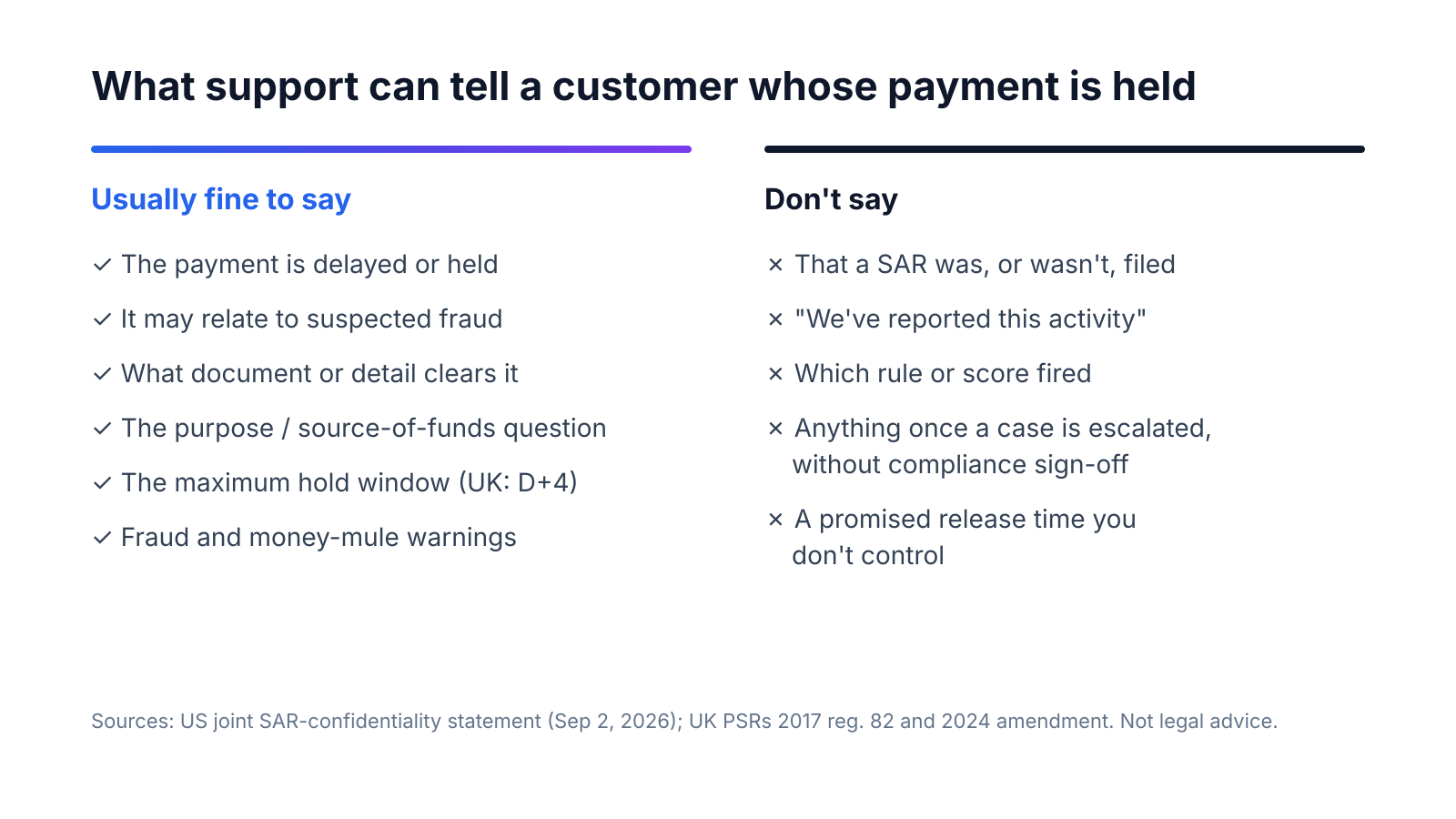
The practical rule: script the 95% and gate the 5%. False-positive holds get fast, plain answers. Anything escalated goes to compliance before a word is written.
The best transaction monitoring software is the one your support team can answer for
Choose on detection, then on whether a hold can reach the customer conversation with the right facts and the right silence.
Pick ComplyAdvantage or Tookitaki for data depth, Unit21 for an AI-run alert queue, Fraud.net or SEON for published prices, and Facctum if payment screening matters as much as monitoring. Then ask every vendor the question their pages skip: when an alert holds a payment, what does the support agent see, and what are they allowed to say? Pair the answer with your payment orchestration stack and your plans for AI agents in banking.
Holds become tickets. Aissist's AI agents answer the "why is my payment on hold" conversation inside your helpdesk, within the disclosure rules your compliance team sets. See Aissist for banking and fintech →
Frequently asked questions
What is the best transaction monitoring software for a fintech startup?
ComplyAdvantage and SEON publish entry prices, but monitoring sits on their custom tiers. Fraud.net's AWS listing — $10,000 a year for 500,000 transactions — is the clearest published monitoring price we found.
How much does AML transaction monitoring software cost?
Most vendors quote privately. Of the six here, only Fraud.net publishes a monitoring price: $10,000 for 12 months covering 500,000 transactions, then $0.02 per transaction.
What percentage of AML alerts are false positives?
PwC research, as cited by Youverify, puts it at 90–95% of transaction monitoring alerts. Vendor-claimed reductions range up to Unit21's "up to 93% fewer."
Can I tell a customer why their payment is frozen?
Usually you can say it is held, that it may relate to suspected fraud and what will clear it. You cannot reveal that a suspicious activity report was filed.
Is transaction monitoring the same as sanctions screening?
No. Screening checks names against sanctions and PEP lists; monitoring checks behaviour across transactions over time. Most platforms here sell both.
Changelog
- Nov 17, 2026: First published. Prices, pages and the September 2026 US joint statement verified.