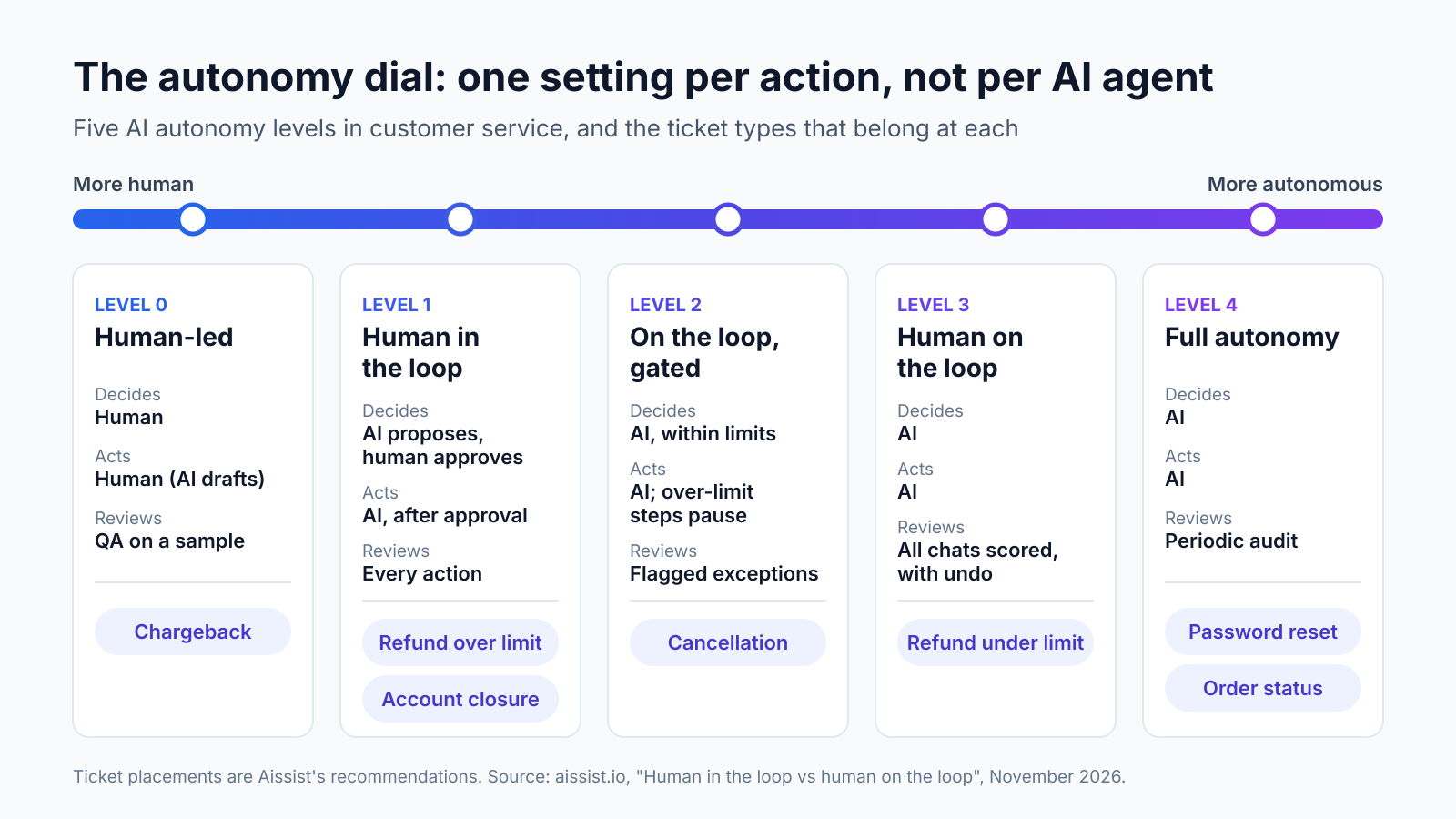
Human in the loop vs human on the loop is decided per action, not per AI agent. This guide places seven common support tickets, from password resets to chargebacks, on a five-level autonomy dial and shows what each wrong setting costs.
TL;DR: The right autonomy level for each ticket type is capped by three facts: whether the AI can execute the action, log it and reverse it. Policy can move the setting below that cap, but never above it.
Methodology & sources
- Compared against the published guides from Decagon, Parloa, Kustomer and Zingtree.
- Evidence: Gartner forecasts, Acxiom's 2027 CX Trends research, Moffatt v. Air Canada, Solidroad's QA data and the EU AI Act text.
- Aissist figures: 83% average resolution and 4.8/5.0 CSAT, as published on aissist.io.
- Verified November 2026. Disclosure: this is Aissist's blog; Aissist sells AI agents that run at these autonomy levels.
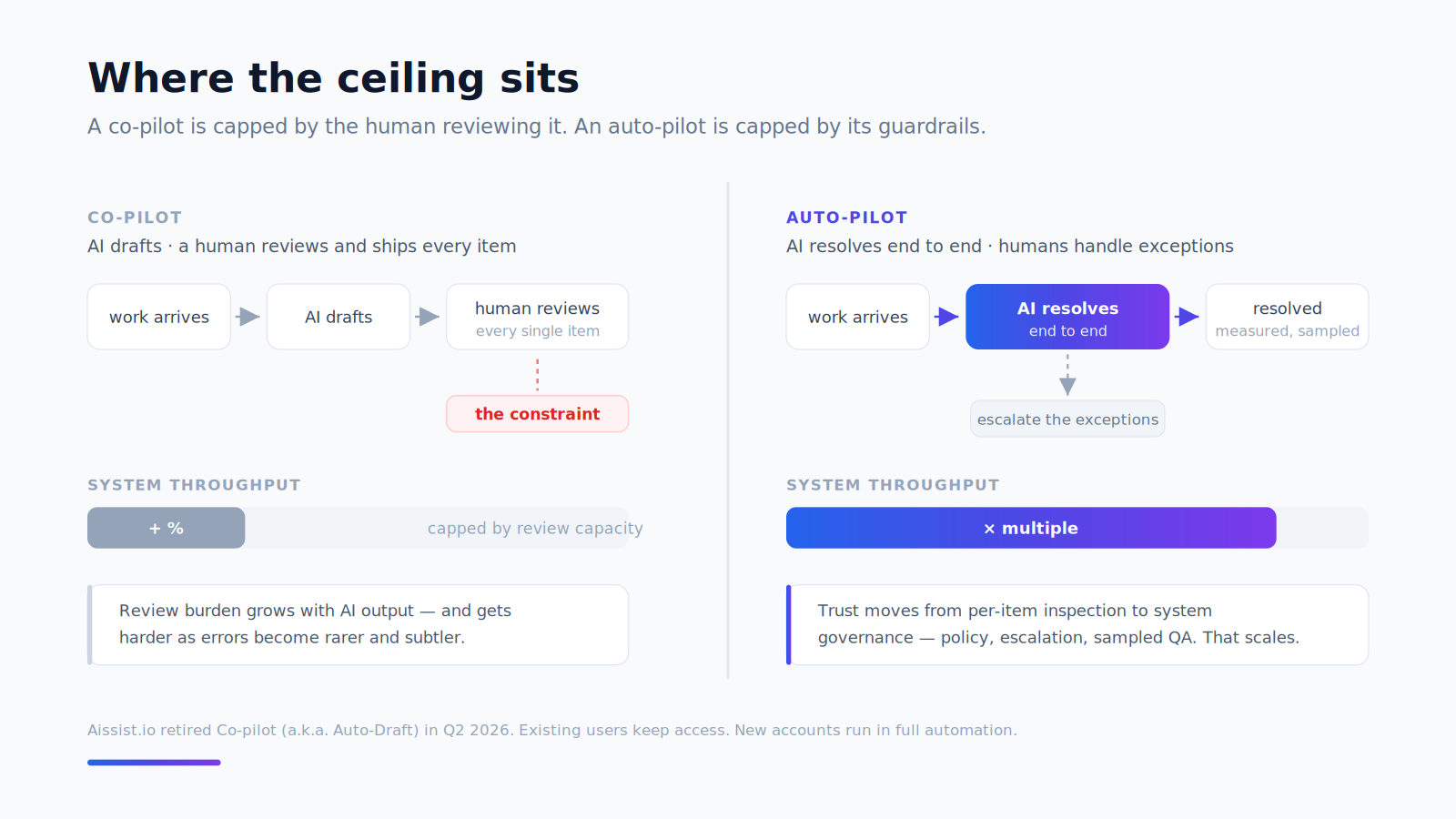
This article sets the oversight level per ticket type. For the copilot-or-autopilot decision across a whole deployment, see AI copilot vs autopilot.
What is the difference between human in the loop and human on the loop?
With human in the loop, a person approves each AI action first; with human on the loop, AI acts and a person can intervene.
The difference is timing. In the loop, the human sits before the action, so nothing happens until someone clicks approve. On the loop, the human sits beside it: the AI resolves the ticket, a supervisor watches the stream, and steps in on the cases that look wrong. A third setting, human out of the loop, removes the real-time role entirely; people set the rules in advance and audit afterwards.
Each setting buys something and costs something. In the loop buys certainty and costs speed, because the approval queue becomes the service level. On the loop buys speed and costs certainty, because the supervisor sees a mistake after the customer does. Out of the loop buys scale and costs visibility, unless every conversation is measured.
The pressure is all in one direction. Gartner predicts that agentic AI will autonomously resolve 80% of common customer service issues without human intervention by 2029, with a 30% cut in operational costs. That forecast is a statement about which tickets will move out of the loop. It says nothing about how to pick them.
The useful question is therefore not "in or on?" It is "which setting does this action earn?" That is what graduated autonomy for AI agents means in practice: one dial per action, not one switch per deployment.
What are the AI autonomy levels in customer service, and which tickets belong at each?
Customer service AI runs at five autonomy levels, from human-led to fully autonomous, and each ticket type belongs at the highest level its action can safely support. The table places seven common ticket types.
| Level | Who decides | Who acts | Who reviews | Ticket types that belong here | What failure looks like |
|---|---|---|---|---|---|
| 0 — Human-led | Human | Human, with AI drafts | QA on a sample | Chargeback | Slow, but errors are caught before the customer sees them |
| 1 — Human in the loop | AI proposes, human approves | AI, after approval | The approver, every action | Refund over threshold, account closure | Approvers rubber-stamp; the queue becomes the SLA |
| 2 — On the loop, gated | AI, within hard limits | AI; anything over a limit pauses | Human, on flagged exceptions | Cancellation | A limit set too loose, so the exception never fires |
| 3 — Human on the loop | AI | AI | Human, on scored conversations, with undo | Refund under threshold | The wrong refund has already gone out; recovery is a reversal |
| 4 — Full autonomy | AI | AI | Periodic audit | Password reset, order status | Silent drift that nobody notices for weeks |
Two placements need explaining. If the bank is already moving the money, keep a human leading, because an AI that "helpfully" refunds a charged-back order pays the customer twice. If the action deletes an account, keep a human approving, because deletion has no undo button.
Aissist runs this split for Nubrakes, a mobile brake repair company, per its hybrid-team case study. The AI diagnoses the problem and answers questions; at price and scheduling, it hands staff a summary and suggested next steps. Nobody approves the diagnosis. Everybody approves the price.
What does it cost to set the autonomy dial wrong?
Setting the dial too low burns the saving on tickets that never needed a person; setting it too high means the mistake has already reached the customer. Both errors are common, and they fail differently.
Too low looks safe and is merely expensive. A human approving every password reset spends roughly the time it takes to do the reset, so the automation saves nothing and adds a queue. Multiply that across order-status checks and you have built a slower help desk with an AI in it.
Too high is the one that makes the news. Klarna said its AI was handling two-thirds of customer service chats in its first month, the work of 700 agents. By May 2025, its CEO was telling Bloomberg the company would hire humans again, as reported by Mind the Product:
"…what you end up having is lower quality." — Sebastian Siemiatkowski, CEO, Klarna, speaking to Bloomberg
The cost of "too high" also scales with the action. On an order-status reply, a mistake is an apology. On a refund dispute, a human merely on the loop means the refund already went out.
"In the payments space, even one incorrect answer or unapproved action is a real problem…" — Todd Sale, SVP of Customer Experience Operations, Corpay
Gartner expects more than 40% of agentic AI projects to be cancelled by the end of 2027, citing costs, unclear value and inadequate risk controls. The dial is where risk control lives.
Why is the autonomy dial a property of the system, not a policy setting?
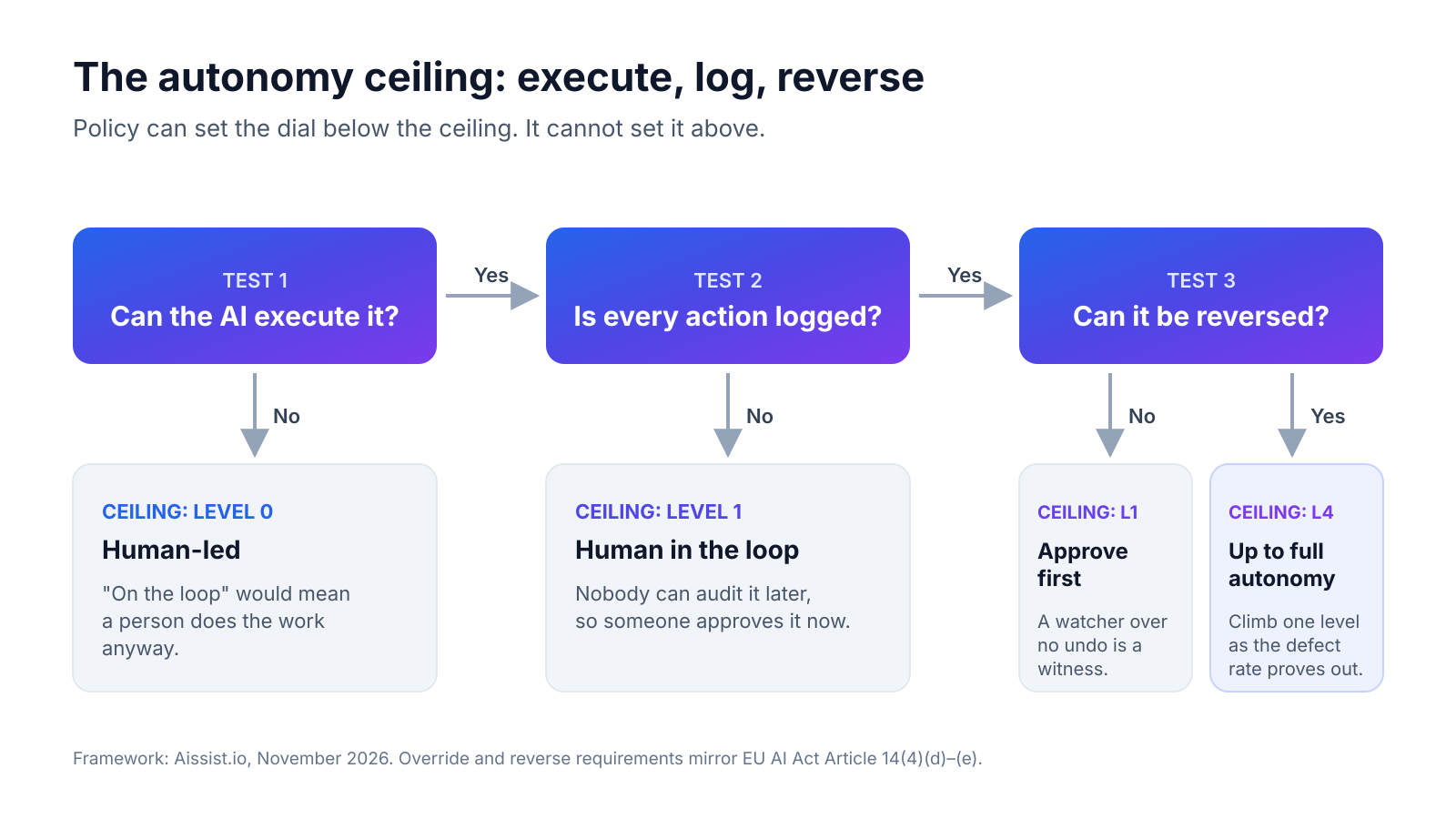
An AI agent can only run at an autonomy level its system supports: it must be able to execute the action, log it, and reverse it. Policy can set the dial lower than that ceiling. It cannot set it higher.
Take the three tests in order. Execute: you cannot put a human on the loop over an action the AI cannot take. If the agent can't issue the refund in your billing system, "on the loop" means a person does the refund, which is Level 0 with extra steps. Log: you cannot take a human out of the loop on an action nobody can audit. Reverse: on-the-loop oversight assumes a supervisor can undo what they catch. Over an irreversible action, a human on the loop is not a supervisor. They are a witness.
The law reads the same way. Article 14 of the EU AI Act requires that overseers of high-risk systems can override or reverse an output and halt the system, from 2 December 2027 for standalone systems. Most support AI isn't high-risk, but Article 14 is the clearest spec of what on-the-loop requires.
The cost of skipping the log test is on record. In Moffatt v. Air Canada, the airline argued its chatbot was responsible for its own words. The British Columbia tribunal disagreed and awarded CA$650.88 in damages, as CTV News reported:
"I find Air Canada did not take reasonable care to ensure its chatbot was accurate." — Christopher C. Rivers, Tribunal Member, British Columbia Civil Resolution Tribunal
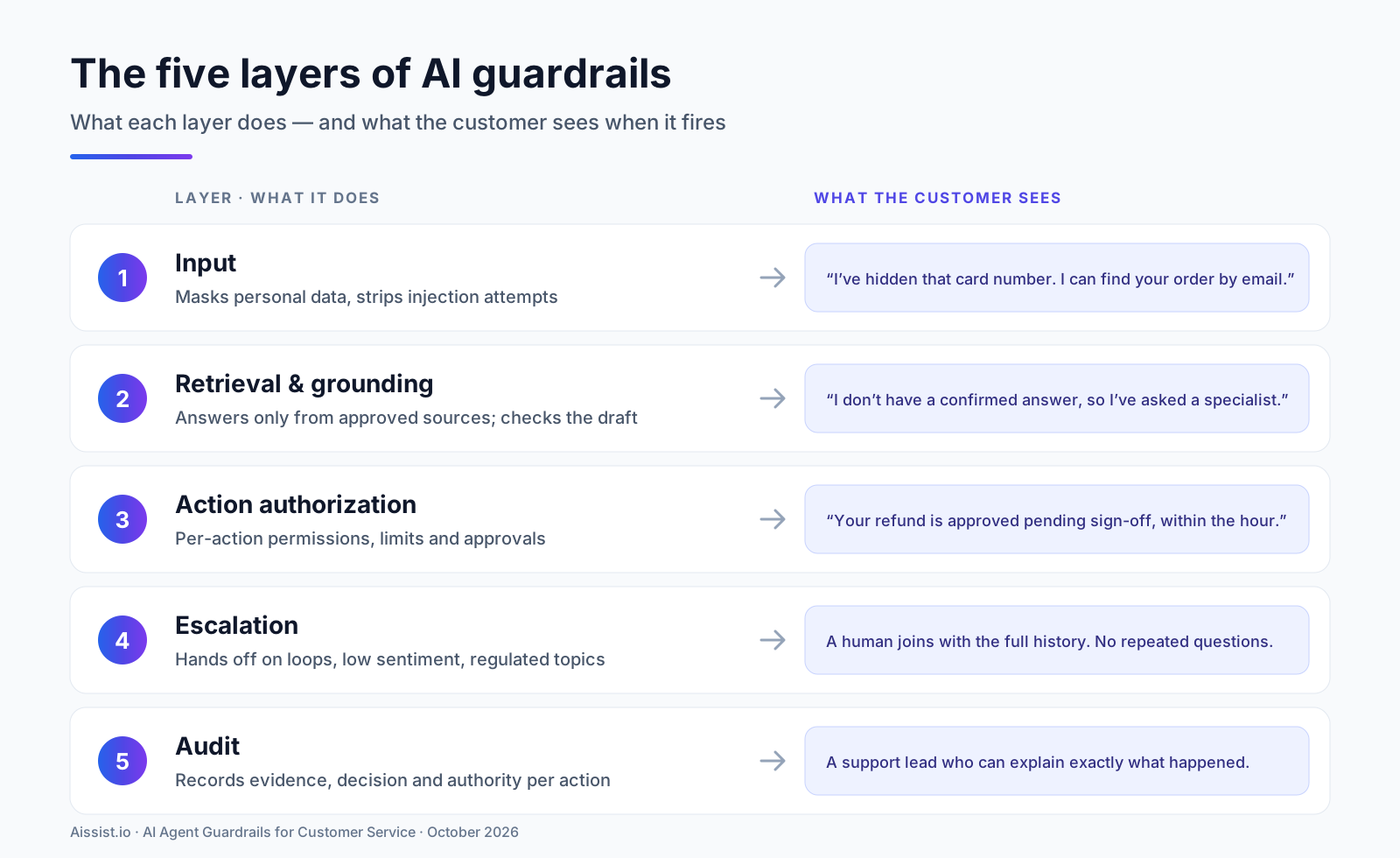
This is the AI Operational Layer argument in one term: autonomy is earned by the plumbing under the model. In Aissist's design, the model proposes an action; only the governance layer can let it run.
What five conditions must hold before you take the human out of the loop?
Take the human out of the loop on a ticket type only when the action is reversible, audited, escalatable, measured on that intent, and owned by a named person. Miss one and the ticket stays a level lower.
- Reversibility. The action can be undone inside the system the AI used, by someone other than the AI. Refunds under a threshold pass; account deletion does not.
- Audit trail. Every action is logged with its inputs, the policy it was checked against and the result, so anyone can reconstruct why it happened.
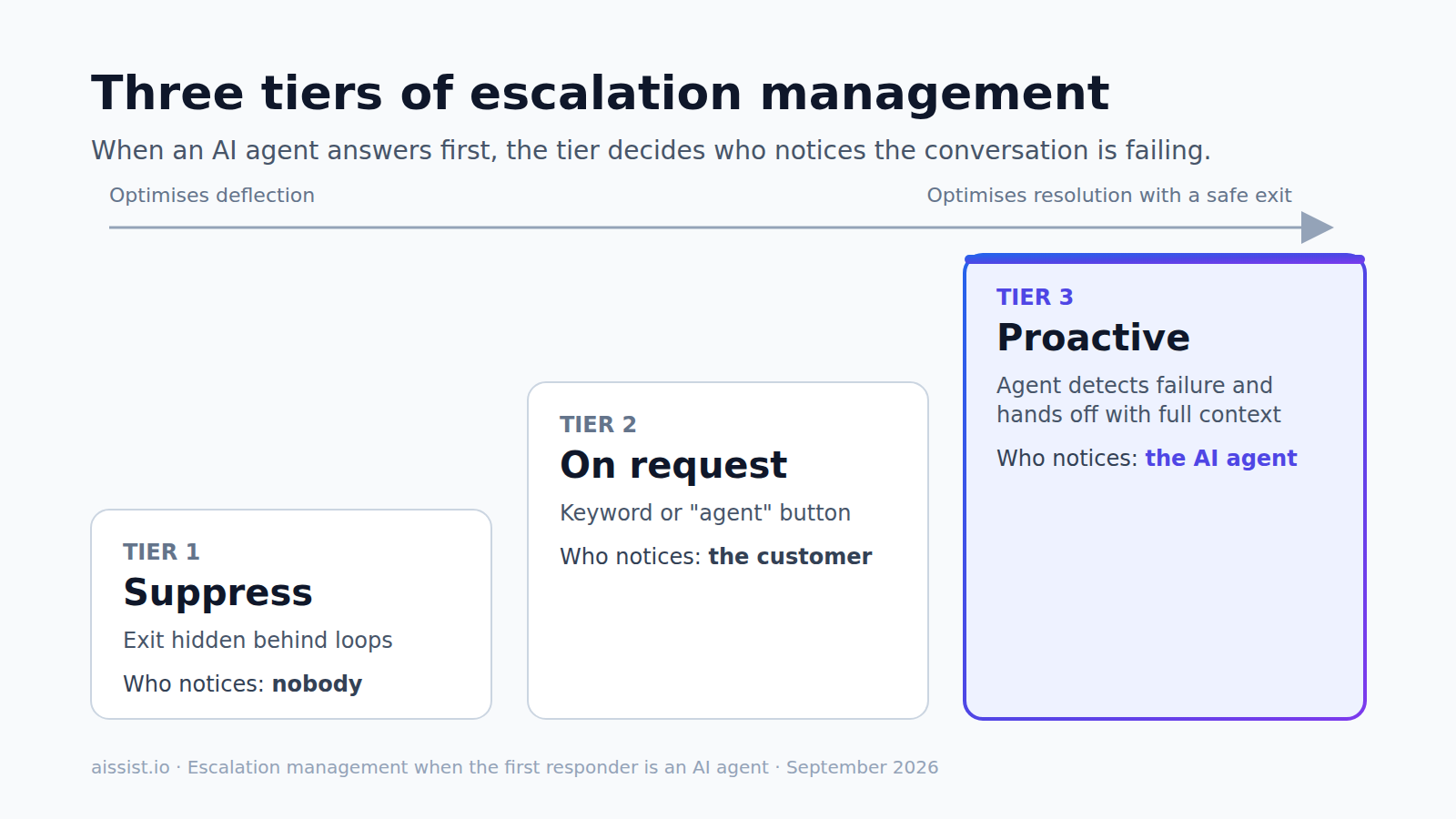
- Escalation path. The AI can hand off mid-conversation with full context, by rule rather than by failure. Aissist calls this proactive escalation, and its escalation management guide sets the triggers queue by queue.
- Defect rate on that intent. Measure errors per ticket type across every conversation, not a sample. Solidroad notes manual QA reviews only 1–2% of interactions, which is not oversight; it is a raffle. Aissist's case for scoring all of them is on its evaluable AI page.
- A named owner. One person answers for each autonomous intent. In Acxiom's 2027 CX Trends research, 48% of brands said establishing accountability when something goes wrong will be a challenge.
Aissist moves customers up the dial this way: AI drafts under human review first, then auto-pilot once performance clears an agreed threshold. Across deployments, Aissist reports an 83% average resolution rate and 4.8/5.0 CSAT.
Set the dial by what the system can undo, not by how confident the AI sounds
Human in the loop and human on the loop are not rival philosophies. They are two positions on one dial, and the dial is set per action. Start every ticket type at the level its system can support: execute, log, reverse. Then move it up one level at a time as the defect rate on that intent proves out, with a named owner watching. Password resets reach full autonomy quickly. Chargebacks may never leave human hands, and that is a correct outcome, not a failure of ambition.
Find out which of your intents can move up the dial. Aissist scores every AI conversation, so you can see which intents have earned more autonomy. Book a demo →
Frequently asked questions
What is human on the loop?
Human on the loop is an AI oversight model where the system acts on its own while a person monitors outcomes and can intervene, correct or stop it. It suits high-volume, reversible actions such as refunds under a set threshold.
When should AI escalate to a human?
AI should escalate when a predefined rule fires, not only when it fails: a regulated or vulnerable topic, an action above its limit, an explicit request for a person, falling sentiment or a repeated intent. The handoff should carry the full conversation context.
What does human out of the loop mean?
Human out of the loop means no person plays a real-time role: people set the rules beforehand and audit results afterwards. It fits read-only or easily reversed tasks, such as order status lookups and password resets, where every conversation is still measured.
Is human in the loop always safer?
No. Human in the loop is only as safe as the approver's attention, and reviewers who approve hundreds of correct actions start rubber-stamping. It also adds queue time to tickets that never needed a person, which customers experience as slower service.
What is graduated autonomy for AI agents?
Graduated autonomy means each AI action earns its own oversight level and moves up one level at a time as its measured error rate on that intent stays low. A deployment can run password resets fully autonomously while keeping chargebacks human-led.
Does the EU AI Act require human in the loop?
Not per action. Article 14 requires that high-risk AI systems can be effectively overseen, including the ability to override, reverse or stop them. It applies to standalone high-risk systems from 2 December 2027; most support AI is not high-risk.