The 4 Best Workforce Management Software Tools for Support Teams in 2026
Compiled by Lifan Xu. Published October 28, 2026 · Last updated October 28, 2026.
Workforce management software forecasts contacts and schedules people to answer them. Every tool below does that well. This roundup adds the question the category hasn't caught up with: what happens to the forecast when an AI agent already resolves part of the queue?
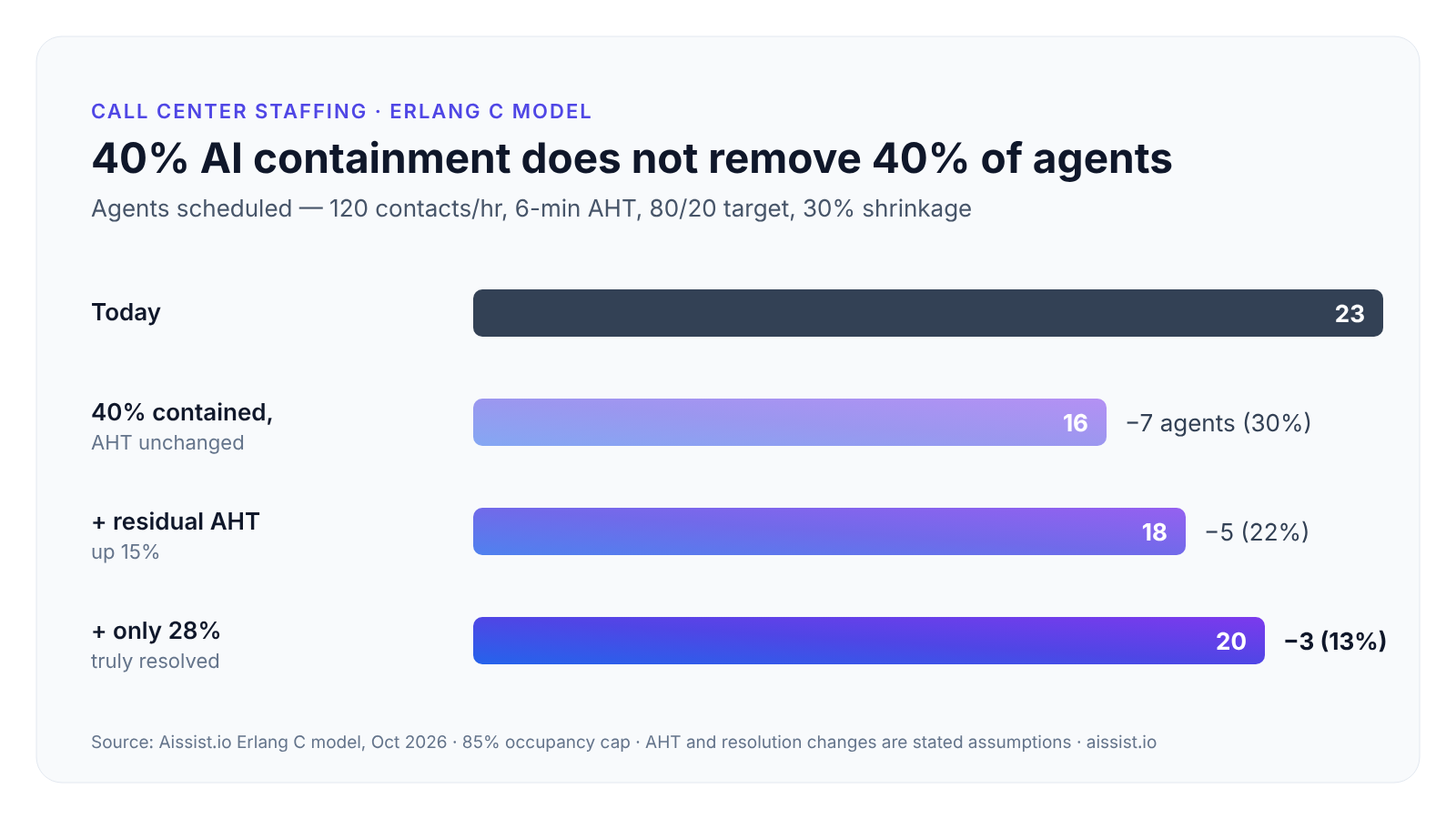
TL;DR: None of the four WFM specialists here documents a native way to forecast AI-resolved volume, and Aissist.io's own Erlang C model shows why that matters: 40% AI containment removed only 13–38% of scheduled agents, not 40%.
- Peopleware (formerly injixo) — best for helpdesk-first support teams on Zendesk or Freshworks
- Calabrio WFM (Verint) — best for inbound centers that want fast deployment and already buy from Verint
- Aspect Cloud Workforce — best for large, complex operations planning humans and bots together
- Cinareo — best for scenario-planning the human-versus-AI headcount mix on top of any WFM
Methodology & sources
- Vendor product, pricing and integration pages, plus each vendor's 2026 press releases; G2 ratings read from G2 product pages. All checked 28 October 2026.
- Published reference prices from the Amazon Connect pricing appendix and Genesys Cloud CX pricing.
- Staffing math from Aissist.io's published Erlang C model.
- Ordered by typical team size, smallest first — not ranked. CCaaS suites (NICE, Genesys, Five9, Talkdesk) and WFM vendors that also sell AI support agents (Assembled) are excluded so the list stays about planning tools.
- Disclosure: this is Aissist.io's blog. Aissist sells AI agents, not WFM software. No vendor paid for placement.
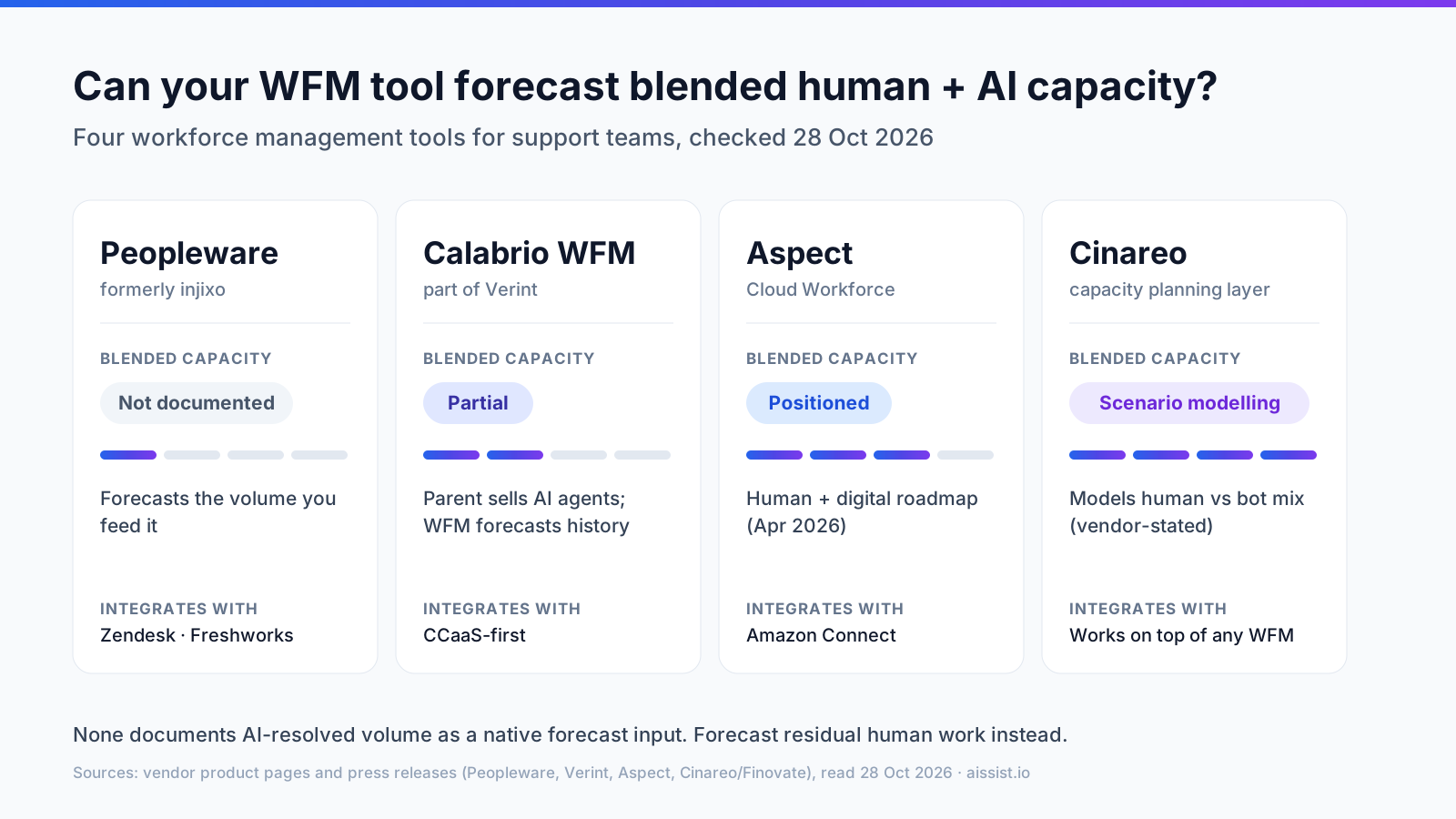
Which workforce management software can forecast blended human and AI capacity?
None of the four documents it as a native forecast input; Aspect and Cinareo come closest, Calabrio's parent sells the AI agents, and Peopleware forecasts whatever volume you feed it. The table shows where each one stands.
| Tool | Forecasting model | Blended human + AI capacity? | Intraday re-forecasting | Helpdesk integrations | Pricing mechanic | G2 (Oct 2026) |
|---|---|---|---|---|---|---|
| Peopleware | AI forecast, 24-month view | Not documented | Yes | Zendesk, Freshworks native; REST API | Custom quote, pay-per-use | 4.4 (30) |
| Calabrio WFM | AI/ML on historical interactions | Partial — parent Verint sells AI agents | Yes, with real-time alerts | CCaaS-first; none listed on product page | Quote only | 4.4 (444)* |
| Aspect Cloud Workforce | Forecast dashboard with predictive AI | Positioned (April 2026); not yet a documented input | Yes; intraday automation announced as upcoming | Amazon Connect, Intradiem, Workday | Quote only | 4.2 (315) |
| Cinareo | Scenario-based capacity planning | Yes, as what-if scenarios (vendor-stated) | No — weekly to 3-year plans | Genesys Cloud CX; works alongside any WFM | Not published | Too few reviews |
*G2 rates the Calabrio ONE suite, not WFM alone.
Every vendor now markets AI forecasting. That means a machine-learning model predicting contacts — not a model of what your AI agent will take off the queue. Different problems; only one gets a column on most roundups. The CloudTalk and HiveDesk lists we checked, for example, have none — and each puts its own product first.
1. Peopleware — best for helpdesk-first support teams
Peopleware is a cloud workforce management suite — formerly sold as injixo — that forecasts, schedules and manages intraday staffing for contact centers and outsourcers. It says it launched Europe's first AI-driven WFM forecast in 2014 and offers a 24-month forecasting view.
Key facts: native Zendesk and Freshworks connectors plus Five9, Talkdesk and a REST API · custom pricing, described by Vonage as pay-per-use · G2 4.4 from 30 reviews.
- Pro: one of the few specialists with native helpdesk connectors rather than CCaaS-only feeds.
- Pro: capacity planning, scheduling and time-off live in one suite.
- Con: no documented way to separate AI-resolved volume from the forecast.
- Con: no public price; the injixo-era list price is no longer published.
Our take: the natural fit for a 20–200 agent team on Zendesk or Freshdesk. Teams whose AI agent already resolves a large share should feed it residual volume, not total contacts.
2. Calabrio WFM (Verint) — best for fast-deploying inbound centers
Calabrio WFM is Verint's mid-market workforce management product for inbound contact centers, covering AI forecasting, automated scheduling, intraday optimization and real-time adherence. Thoma Bravo combined Calabrio with Verint after closing the Verint acquisition in November 2025, and the combined company took the Verint name in February 2026, keeping the Calabrio product line.
Key facts: Verint says its scheduler handles 50 to 50,000 agents, with Paychex reporting $500K+ in annual savings in a published case study · quote only · G2 4.4 (444) for the Calabrio ONE suite.
- Pro: Verint also sells conversational AI agents and markets orchestration of "humans and AI agents" on one platform.
- Pro: a Workforce Intelligence layer adds adaptive forecasting on top of existing WFM.
- Con: the WFM page describes forecasting from historical interactions only.
- Con: integrations lean to CCaaS (its showcase is Amazon Connect); no helpdesk connectors are listed.
Our take: strongest if your AI agent also runs on Verint. If it doesn't, the blended view stops at the platform boundary.
3. Aspect Cloud Workforce — best for large hybrid operations
Aspect Cloud Workforce is enterprise workforce management from Aspect Software, the company Alvaria spun its WFM suite into in September 2024. In April 2026 Aspect launched Aspect Intelligence and repositioned around coordinating human agents, bots and automated workflows. Its CEO puts the ambition plainly:
"…see their entire operation clearly — human and digital — and optimize it in real time." — Jeff Kupietzky, CEO, Aspect Software
Key facts: the first Aspect Intelligence release automates schedule updates from adherence; intraday automation is listed as upcoming · integrates with Amazon Connect, Intradiem and Workday, per Capterra · quote only · G2 4.2 (315).
- Pro: the clearest public commitment to planning human and digital work together.
- Pro: partnerships with Cinareo (capacity planning) and Cresta (AI agents and coaching).
- Con: the hybrid positioning is ahead of what the release notes document today.
- Con: enterprise implementation; more than most sub-100-agent teams need.
Our take: ask Aspect to demo a forecast with your bot's volume in it before you sign.
4. Cinareo — best for scenario-planning the human-AI mix
Cinareo is a capacity planning platform that sits on top of an existing WFM tool and models staffing, budget and hiring scenarios from one week to three years out. It is the only tool here whose founder describes human-versus-bot modelling as a customer use case.
"Capacity planning remains relevant in contact centers even if AI is involved." — Karen Elliott, CEO and Co-Founder, Cinareo, via Finovate
Key facts: complements any WFM platform, with a Genesys Cloud CX integration and an Aspect partnership · pricing not published · too few G2 reviews to rate.
- Pro: built for "what if AI resolution is 25%, not 40%?" questions.
- Pro: ties headcount scenarios to budget and recruitment plans.
- Con: no scheduling or intraday; you still need a WFM tool.
- Con: young company (founded 2022) with a short public track record.
Our take: a planning layer, not a replacement. Pair it with any tool above when the automation rate is the biggest unknown in next year's budget.
Why does an AI agent break a standard staffing forecast?
Because an AI agent removes the easy, short contacts first, so human workload falls far less than the automation rate suggests. Forecasting total contacts and staffing to them overstaffs a queue the agent is already clearing; subtracting the containment rate understaffs it.
"If you contain the easy quick ones, your average handle time will go up." — Christina McAllister, Senior Analyst, Forrester, via No Jitter
We ran this through our own Erlang C model before writing this page. At 120 contacts an hour, 40% AI containment cut scheduled agents from 23 to 20 once we counted only truly resolved contacts and longer residual handle times — 13%, not 40% (full worked example). Larger centers kept more of the saving, up to 38%.
Planning is also live again. Forrester's 2027 predictions expect CX staffing to rise 20% after two years of cuts it calls overzealous — with the new hires in AI-supporting roles.
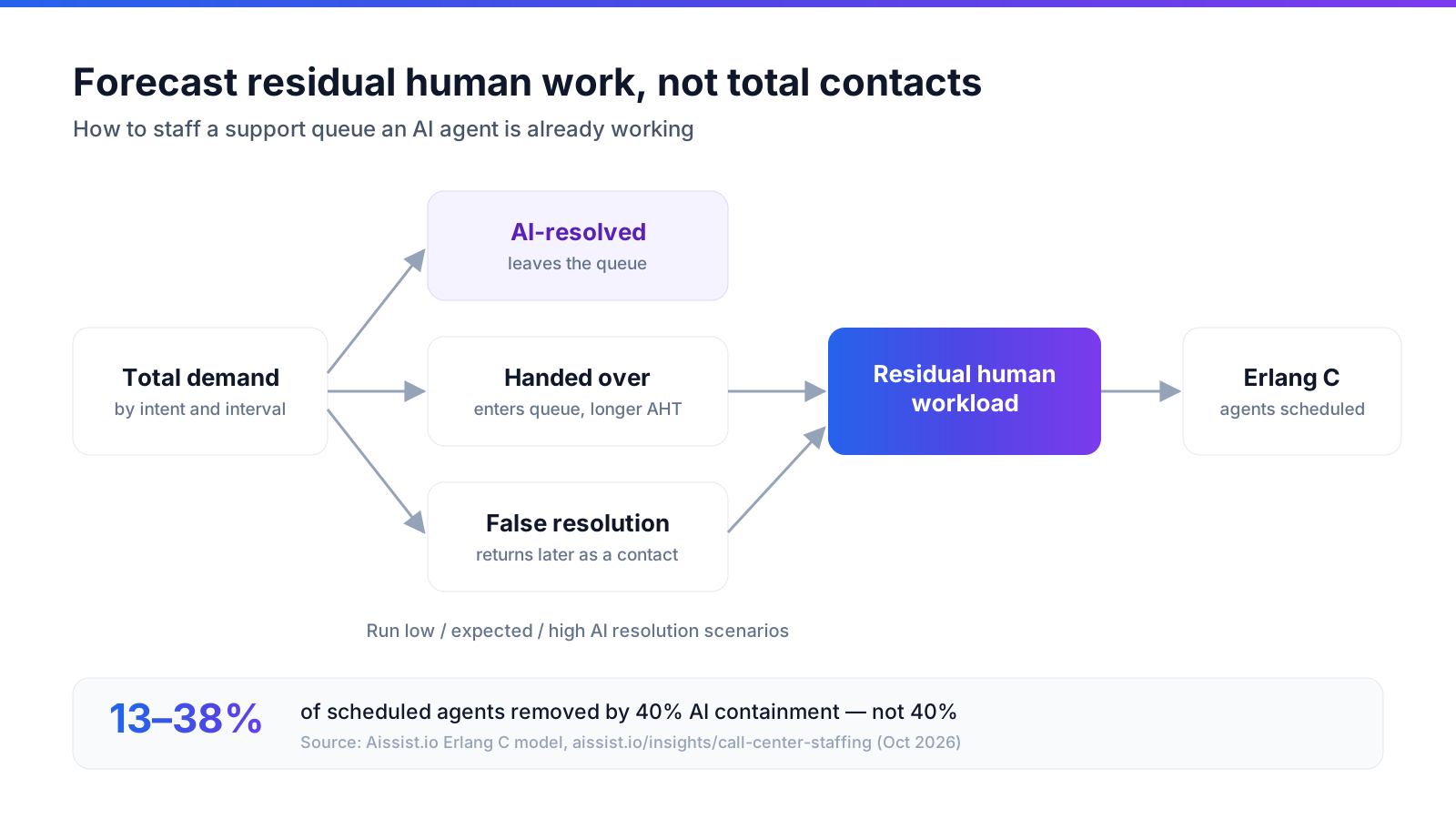
How do you forecast a queue when the AI resolution rate itself varies?
Forecast residual human work, not total contacts, and treat the AI's resolution rate as a range. Five steps work with any tool above:
- Forecast total demand by intent and interval — order status and refunds automate at very different rates.
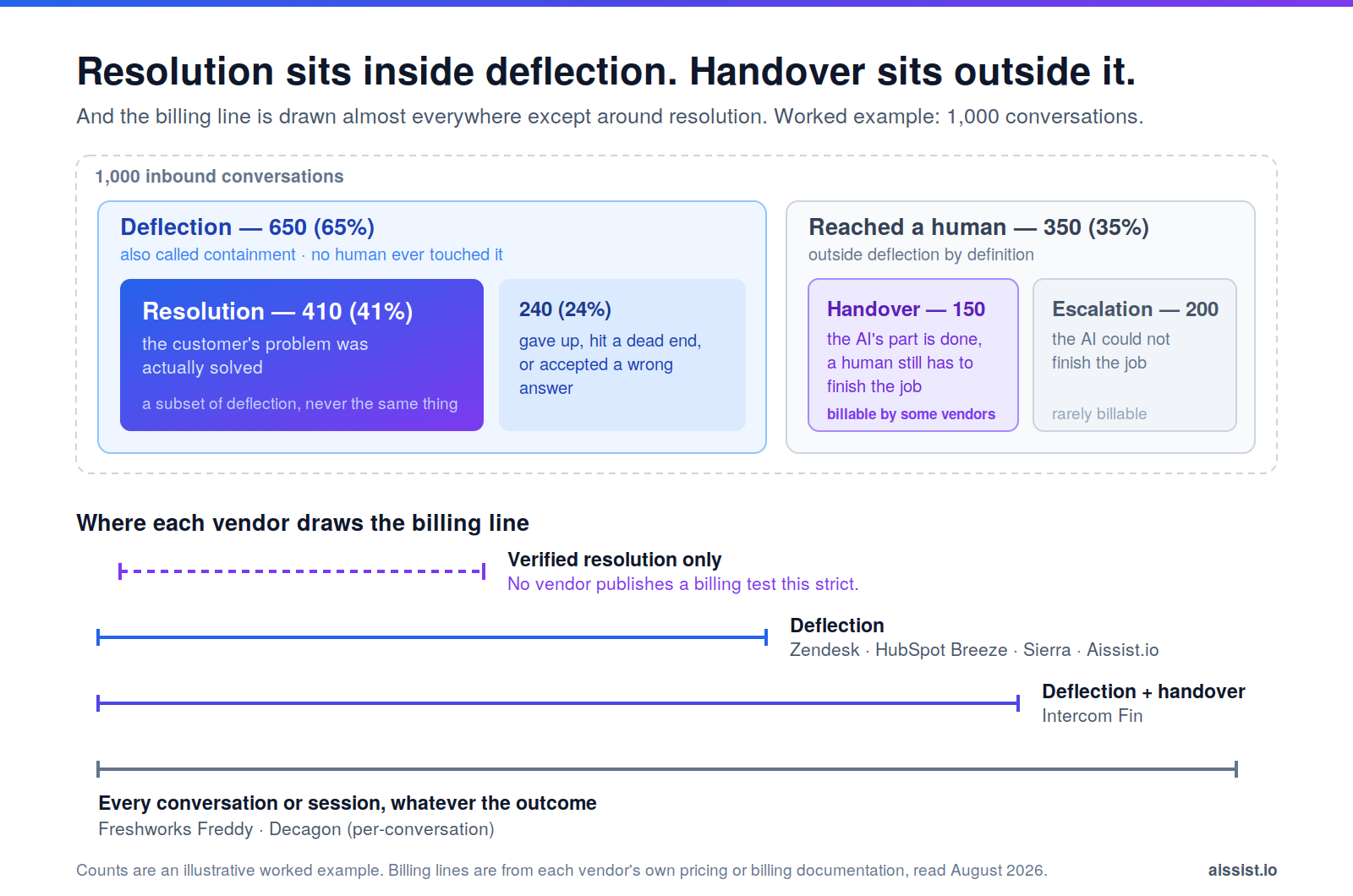
- Split by AI outcome: resolved contacts leave the queue; handovers enter it; false resolutions come back later. Use resolution, not deflection.
- Run three resolution scenarios — low, expected, high — because the rate drifts when policies or knowledge change.
- Raise residual handle time 10–20% until you have measured it.
- Feed the residual to the WFM tool and set an intraday trigger: if AI resolution drops five points by midday, re-forecast.
Our staffing calculator runs steps 3–5 on your numbers.
What does contact center workforce management software cost?
None of the four specialists publishes a price; the only public WFM prices belong to platform suites. Amazon Connect charges $27 per agent per month for each agent who takes a contact in a forecasted queue or receives a schedule (Customer Basic; included in the Connect Customer channel rate). Genesys bundles forecasting and scheduling into its CX 3 tier at $155 per user per month, billed annually.
| 40-agent team (Oct 2026) | Monthly | What you're buying |
|---|---|---|
| Amazon Connect forecasting & scheduling | $1,080 | WFM only, on Connect |
| Genesys Cloud CX 3 | $6,200 | Full CCaaS seat with WFM |
| Peopleware, Calabrio, Aspect, Cinareo | Quote only | Standalone WFM or planning |
Budget the blended forecast either way: buying seats for contacts your AI agent already resolves is the most expensive line nobody audits.
How should a support leader choose?
- If you run Zendesk or Freshdesk with under 200 agents, start with Peopleware, because native helpdesk connectors save weeks of data plumbing.
- If your AI agents run on Verint, choose Calabrio, because the blended view only works inside one platform today.
- If you operate several sites and unions, shortlist Aspect, and make a bot-inclusive forecast part of the demo.
- If next year's automation rate is your biggest unknown, add Cinareo above whichever WFM you keep.
Plan for residual work, not total contacts
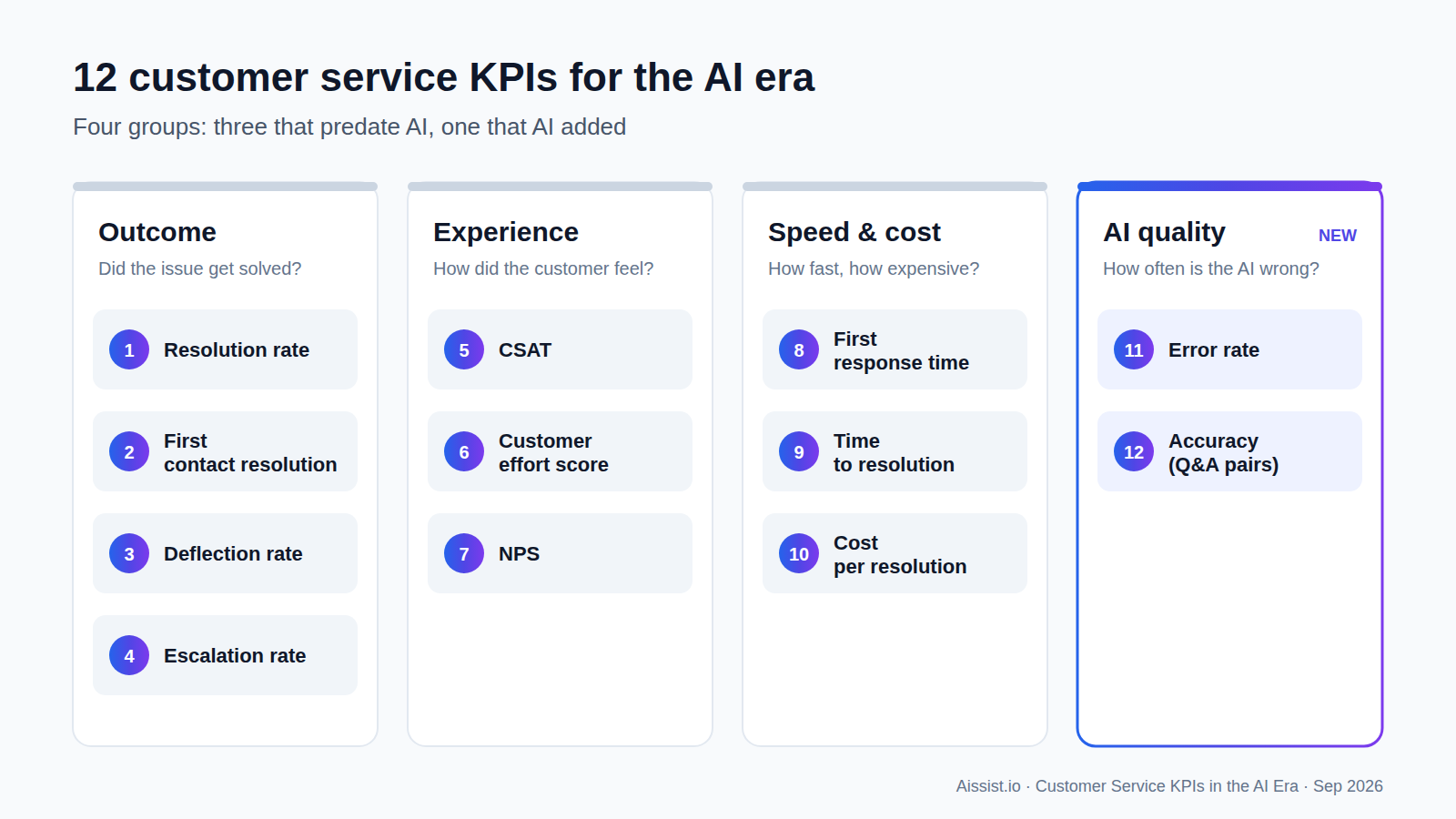
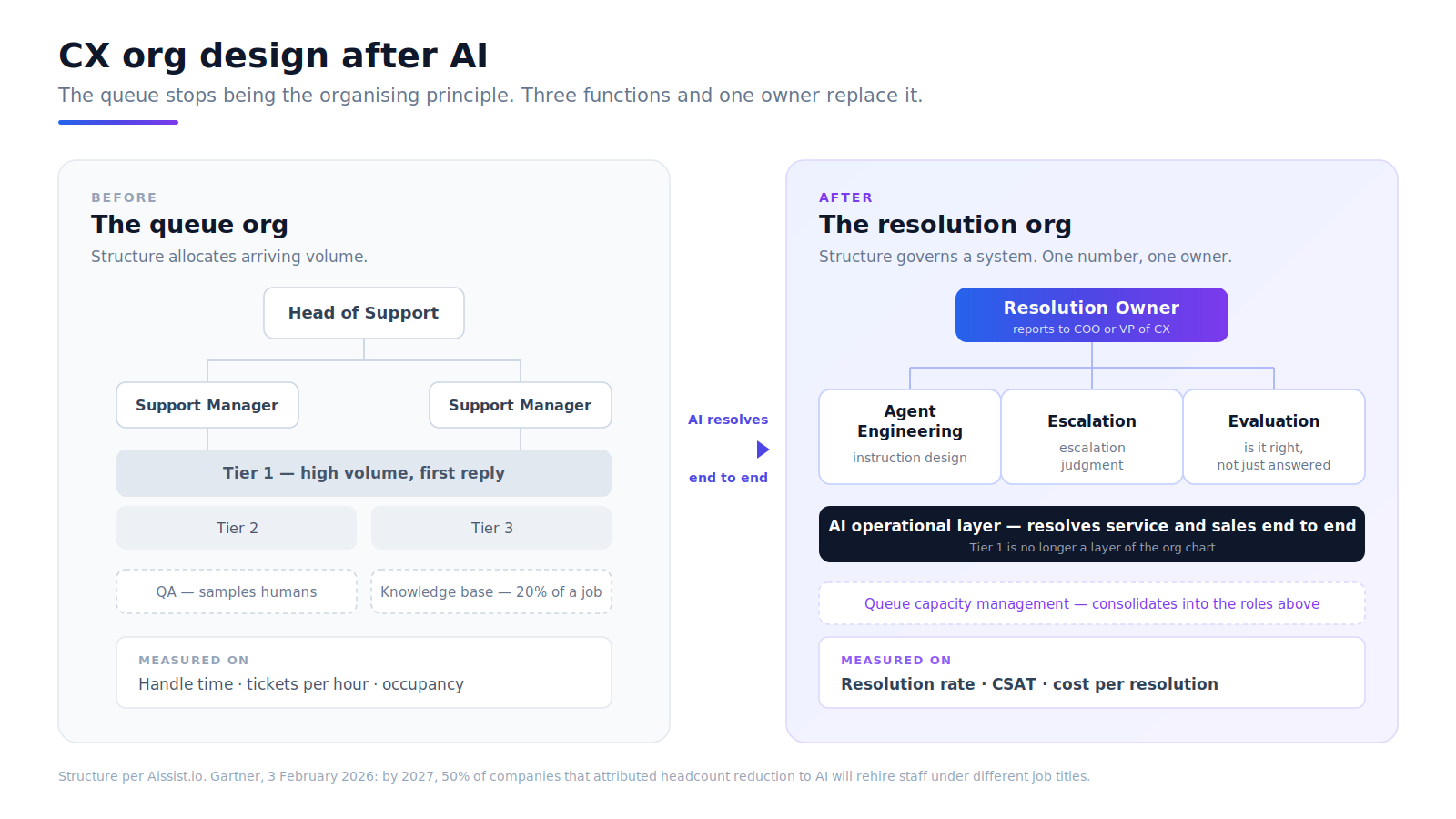
None of these tools yet treats your AI agent as a second workforce with its own, variable capacity — so that model has to come from you. Give your WFM tool the queue humans will actually see. The vendor matters less than the number you feed it; for what to track once it's live, see our customer service KPIs CX org design for AI, and, if you staff through an outsourcer, AI vs BPO for customer support.
Frequently asked questions
What is workforce management software for support teams?
Workforce management software forecasts contact volume, converts it into staffing requirements, builds schedules and manages intraday changes and adherence. Support teams typically adopt it beyond about 20 agents or once they add live chat or phones.
Can WFM software forecast AI agent volume?
Not natively in the four specialists reviewed here. Aspect positions its platform for human and digital work, and Cinareo models human-versus-bot scenarios, but the dependable method is forecasting residual human volume after AI resolution.
Is injixo the same as Peopleware?
Yes. Peopleware, formerly InVision, launched the cloud product injixo in 2011 and now sells it under the Peopleware name. G2 lists it at the same profile.
Are Calabrio and Verint the same company?
Yes. Thoma Bravo combined them after closing its Verint acquisition in November 2025; the company adopted the single name Verint in February 2026 and kept Calabrio as a product line.
Is Alvaria the same as Aspect?
Alvaria moved its workforce engagement suite to the revived Aspect brand in September 2024. Aspect now sells the WFM products; Alvaria focuses on outbound contact-center technology.
Changelog
- 28 October 2026 — First published. Vendor features, integrations, pricing and G2 ratings checked on this date.