The 9 Best Help Scout Alternatives and Competitors for 2026
The best Help Scout alternatives in 2026 are Front, Zendesk, Freshdesk, Intercom, Hiver, Zoho Desk, Gorgias, HubSpot Service Hub, and Gladly. The right one depends on whether you need lower cost, more depth, a phone channel, or an AI agent that resolves conversations rather than drafting replies for a human. This guide compares all 10 on real G2 ratings, verified pricing, and best-fit use case — and then covers a different path: adding an agentic AI layer on top of the platform you land on, instead of just moving your inbox. For the wider market, see our best help desk software guide.
Help Scout's whole design argument is restraint — a shared inbox, a knowledge base, and as little to configure as possible. That is exactly why teams outgrow it rather than sour on it. Below is a neutral, data-backed comparison so you can shortlist quickly.
Why teams look for a Help Scout alternative
Help Scout is a well-built product with a clear philosophy: a shared inbox, a customer-facing knowledge base, and as little administration as possible. It rates 4.4 on G2 across 431 reviews and 4.6 on Capterra across 226. Most teams that leave aren't unhappy with the product — they've hit a specific ceiling.
There is no native phone channel. This is the clearest functional gap. Help Scout's pricing comparison lists voice calling as "via integration" on paid tiers only, and its own documentation describes routing voicemail notifications into an inbox as email with an audio attachment. That's voicemail handling, not telephony. Real calls require Aircall, Talkdesk or JustCall bolted on. If your support is drifting toward phone, you're buying a second product.
The Pro tier has a 10-user minimum. Pro is $75 per user per month with "unlimited (minimum 10)" users — a $750/month floor before you've added anyone beyond ten. For a team of twelve that's fine. For a team of six that wants one Pro feature, it isn't.
Custom reporting is gated two tiers up. Standard gets pre-built reports with two years of history and no custom reports or exports. Custom reporting and exports start at Plus ($45/user/mo). Round-robin assignment is also Plus and above; load-balanced routing is Pro only. None of that is unreasonable, but it means the entry tier is thinner than the price suggests.
The complaint themes are about depth, not quality. G2's aggregated dislikes are led by lack of features (8 reviewers), limited features and reporting options (7), lack of features versus competitors (7), then limited customization (4), limited functionality (4), and a cluster of three-reviewer themes covering email issues, cost, reporting, interface and analytics. Those are overlapping labels and a single review can populate several, so don't add them up — and every count is small, which is the honest caveat here. At 431 reviews Help Scout has roughly 6% of Zendesk's review volume, so its 4.4 is a less statistically settled number than the majors. That reflects G2 review-solicitation effort as much as install base, so read it as a smaller sample, not fewer customers.
Worth stating plainly, because competitors' comparison pages often get this wrong: Help Scout does have SLA management, CSAT surveys and routing. SLAs run one basic policy on Standard, two advanced on Plus, unlimited on Pro. Satisfaction ratings are built in from Standard up. Those are not the gaps.
If none of this describes you, staying is a reasonable answer. If one or more does, here's the field.
Compiled by Alex Gomez, Sr. Analyst, read on 24 August 2026. Disclosure: this comparison is published by Aissist.io, which sells an AI layer that runs on top of several of the help desks listed below. Ratings, prices and complaint counts come from G2 and each vendor's own pricing page.
How we evaluated these Help Scout competitors
Every platform below is assessed on five things: what it genuinely does better than Help Scout, the verified starting price at list, its G2 rating with review count so you can weight the evidence yourself, the AI capability actually included versus sold separately, and a substantive weakness drawn from aggregated G2 review themes rather than invented for balance.
Ratings are each product's overall G2 score and review count captured in August 2026; prices are each vendor's published entry tier. Both move, so confirm on the vendor's page before you buy. Four naming notes: Intercom's G2 listing now resolves to Fin, Zendesk's is Zendesk for Customer Service, Hiver's is Hiver in Gmail, and Groove has rebranded to Helply with an entirely different pricing model — see the note at the end.
Help Scout alternatives compared at a glance
| Platform | G2 rating | Starting price | Best fit |
|---|---|---|---|
| Help Scout (baseline) | 4.4 (431) | $25 / user / mo (free for 5 users) | The incumbent you're comparing against |
| Front | 4.7 (2,507) | $25 / seat / mo (≤10 seats) | Collaboration-heavy client-facing teams |
| Zendesk | 4.3 (7,044) | $19 / agent / mo | Enterprise scale, routing and reporting depth |
| Freshdesk | 4.4 (3,766) | $19 / agent / mo | Best price-to-feature ratio in full ticketing |
| Intercom | 4.5 (3,904) | $29 / seat / mo + Fin usage | AI-first resolution, priced per outcome |
| Hiver | 4.6 (1,283) | $25 / user / mo (2-seat minimum) | Google Workspace teams who want native Gmail |
| Zoho Desk | 4.4 (7,860) | $7 / user / mo (free for 3 users) | The cheapest full-featured desk |
| Gorgias | 4.6 (575) | $10 / mo (50 tickets, per ticket) | Ecommerce and Shopify merchants |
| HubSpot Service Hub | 4.4 (2,920) | $7 / seat / mo (free for 2 users) | Teams standardised on HubSpot CRM |
| Gladly | 4.7 (1,115) | No public pricing | Consumer brands wanting a customer-centric view |
Prices are per user, seat or agent per month. Help Scout's $25 and HubSpot's $20 figure are billed monthly; Front, Zendesk, Freshdesk, Hiver, Zoho Desk and HubSpot's $7 are billed annually. Gorgias is billed per ticket, not per seat.
The 9 best Help Scout alternatives and competitors
1. Front — best for collaboration-heavy teams
Front is the closest philosophical relative: email-first, shared inbox, minimal ticket ceremony — but with a far deeper rules engine, real internal commenting, and analytics Help Scout reserves for its upper tiers. At 4.7 across 2,507 reviews it is also the highest-rated platform here on any meaningful sample. Best for: agencies, logistics and professional-services teams where several people work the same account. Pricing: Starter $25/seat/mo billed annually for up to 10 seats, Professional $65 up to 50, Enterprise $105 unlimited. Add-ons include Autopilot at $0.05 per conversation and Copilot at $20/seat/mo. Pros: best-in-class collaboration, strong rules engine, polished product. Cons: the largest theme is missing features (67 reviewers), and the next four are all about email handling — tagging (58), confusing search and management (54), general email management (37) and search functionality (35). Also expensive for small teams. G2: 4.7 (2,507).
2. Zendesk — best for enterprise scale
If you're leaving Help Scout because it can't route, report or scale the way you now need, Zendesk is the category answer: SLAs, skills-based routing, a help centre, AI agents and the largest app ecosystem in support software. Best for: support organisations past roughly 25 agents with genuine routing and reporting requirements. Pricing: Support Team $19/agent/mo billed annually; Suite Team $55, Suite Professional $115, Suite Enterprise by quote. Pros: unmatched depth and ecosystem, proven at scale. Cons: you are trading simplicity for capability, and the reviewer data is blunt about the cost — missing features (216), limited features (180), steep learning curve (179), limited customization (158), complexity for beginners (137), expensive (136). See our Zendesk competitors guide.
3. Freshdesk — best price-to-feature ratio
Freshdesk gives you most of what Zendesk does for a fraction of the setup burden, and its $19 tier already includes a knowledge base, customer portal, dispatch rules and reporting. For a team outgrowing Help Scout's Standard tier, it's often the cheapest way to gain depth. Best for: SMB and mid-market teams that want real ticketing without a platform project. Pricing: Growth $19/agent/mo billed annually, Pro $55, Enterprise $89. Freddy AI Agent includes 500 sessions, then $49 per 100; Freddy AI Copilot is a separate $29/agent/mo add-on on Pro and Enterprise. Pros: a lot of help desk for the money, gentle onboarding. Cons: limited live chat (69 reviewers), restricted feature set versus competitors (62), limited customization (58), cumbersome ticket management (55), slow loading (54). G2: 4.4 (3,766). See our Freshdesk competitors guide.
4. Intercom — best AI-first alternative
Help Scout's AI Answers resolves autonomously at $0.75 per resolution; Intercom has built its entire product around the same idea at larger scale with Fin. If the reason you're shopping is "I want AI to actually close conversations," this is the direct comparison. Best for: SaaS and digital-first teams whose customers live in chat. Pricing: Essential $29/seat/mo, Advanced $85, Expert $132 — plus Fin from $0.99 per Fin outcome (Intercom's word is "outcome," which matters when you model cost). Pros: strongest AI resolution in the category, excellent messenger. Cons: missing features (135), AI limitations (117), limited features (103), challenging learning curve (102), poor customer support (81), high pricing (80), inaccuracy (74). G2: 4.5 (3,904), listed as Fin. There's also an Intercom integration if you'd rather keep it and automate on top.
5. Hiver — best for Google Workspace teams
Hiver puts shared inboxes, SLAs, analytics and assignment inside native Gmail. For a team that never wanted to leave Gmail in the first place, it removes the biggest adoption risk in this entire list. Best for: Google Workspace teams who want help-desk workflow without a new interface. Pricing: Growth $25/user/mo billed annually or $35 monthly, two-seat minimum, seats scaling 2 → 5 → increments of 5. Voice is a $30/seat/mo add-on with 1,000 minutes per voice seat — notably, this is a native phone channel Help Scout doesn't have. Pros: zero retraining, real SLAs, genuine voice option. Cons: email issues covering glitches, loading times and data retrieval (72 reviewers), missing features (47), limited features (34). G2: 4.6 (1,283).
6. Zoho Desk — best value
If cost is what pushed you off Help Scout — particularly that Pro floor — Zoho Desk is the cheapest credible full help desk on this list, with a free tier for three agents. Best for: budget-constrained teams, and anyone already running other Zoho apps. Pricing: Express $7/user/mo billed annually (capped at 5 users), Standard $14, Professional $23, Enterprise $40; free for 3 agents. Zia AI begins at Standard with sentiment analysis and Answer Bot; generative reply assistance requires Professional. Pros: unmatched price-to-capability, deep configurability. Cons: the three largest themes are learning curve (297 reviewers), steep learning curve (211) and limited customization (183) — you trade Help Scout's simplicity for a busier interface. G2: 4.4 (7,860). See our Zoho Desk alternatives guide for that field.
7. Gorgias — best for ecommerce
Help Scout is channel- and industry-agnostic. Gorgias is not: it's built for online retail, letting agents refund, cancel and edit orders inside the ticket, and attributing revenue to support conversations. Best for: Shopify, BigCommerce and Magento merchants. Pricing: per billable ticket rather than per seat — Starter $10/mo for 50 tickets, Basic $60 for 300, Pro $360 for 2,000, Advanced $900 for 5,000, with overages at $0.40 or $0.25 per ticket. Its AI Agent is priced at $0.90 per resolved interaction on most plans, rising to $1.00 on Starter. Pros: deep ecommerce actions, unlimited agents from Pro up, revenue reporting. Cons: Starter and Basic cap at 3 agents; steep learning curve (14 reviewers), expensive (7), missing features (7), ticketing issues (7). G2: 4.6 (575). See our Gorgias competitors guide.
8. HubSpot Service Hub — best if you already run HubSpot
The argument is data, not ticketing: support conversations sit on the same record as marketing and sales activity. Best for: revenue teams already standardised on HubSpot CRM. Pricing: Starter $7/seat/mo billed annually or $20 monthly; free for 2 users; Professional $90 annually or $100 monthly — plus a $1,500 one-time onboarding fee on Professional. Pros: one customer record across the funnel, clean UI, genuinely cheap entry tier. Cons: missing features (117), limited customization (93), limited features (88), limited email processing options (75), expensive (56). G2: 4.4 (2,920). There's a HubSpot integration if you want to keep it and add automation.
9. Gladly — best customer-centric model for consumer brands
Gladly inverts the ticket model entirely: the customer is the primary object, with one lifetime conversation across every channel rather than a queue of disconnected tickets. At 4.7 it ties Front for the highest rating here, though on less than half the review base. Best for: consumer brands where the same customers come back repeatedly. Pricing: no public pricing — demo-only, which is a real evaluation cost. Pros: genuinely different and well-executed model, strong for repeat-contact businesses, native voice. Cons: missing features (37 reviewers), limited customization (30), poor reporting (25). Note also that its headline AI resolution figure is a vendor claim, not third-party verified. G2: 4.7 (1,115).
A note on Groove. Groove was for years the default "simpler Zendesk" recommendation alongside Help Scout. As of June 2026 it has rebranded to Helply, with pricing moved to $1 per ticket, a 250-ticket monthly minimum ($250/mo) and a $3,000 annual floor, targeting B2B SaaS. Groove Classic still exists for legacy customers but its seat pricing is no longer published. If a comparison article recommends "Groove at $X per user," it's out of date.
A different path: add an AI layer instead of switching platforms
Every option above asks you to migrate — move conversations, retrain the team, rebuild workflows, and learn a new interface. Sometimes that's right, particularly if you need a phone channel or genuine enterprise routing.
But notice what several of the reasons for leaving have in common. Custom reporting gated two tiers up. A $750 Pro floor. AI that drafts for a human rather than closing the conversation. Those are cost and resolution problems more than help-desk problems, and a migration relocates them rather than solving them.
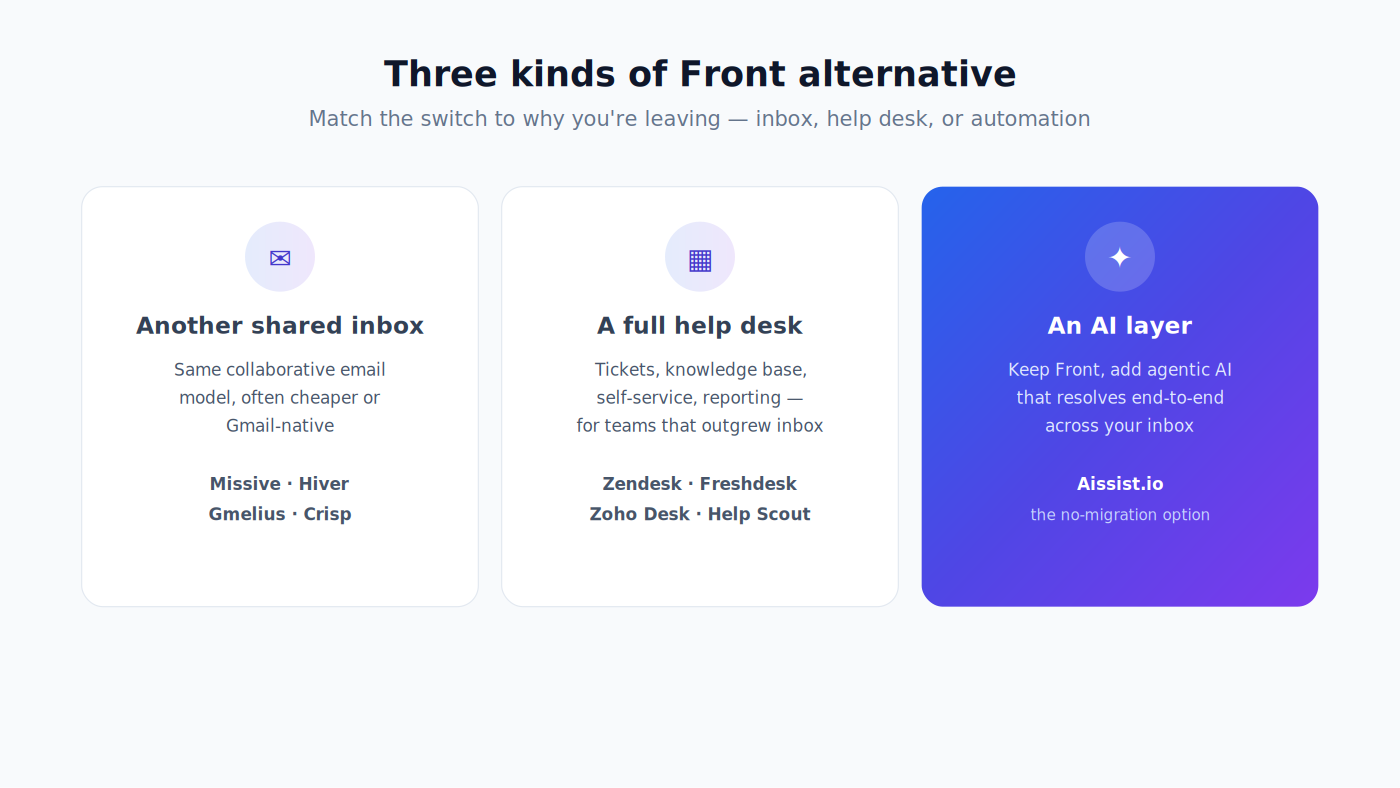
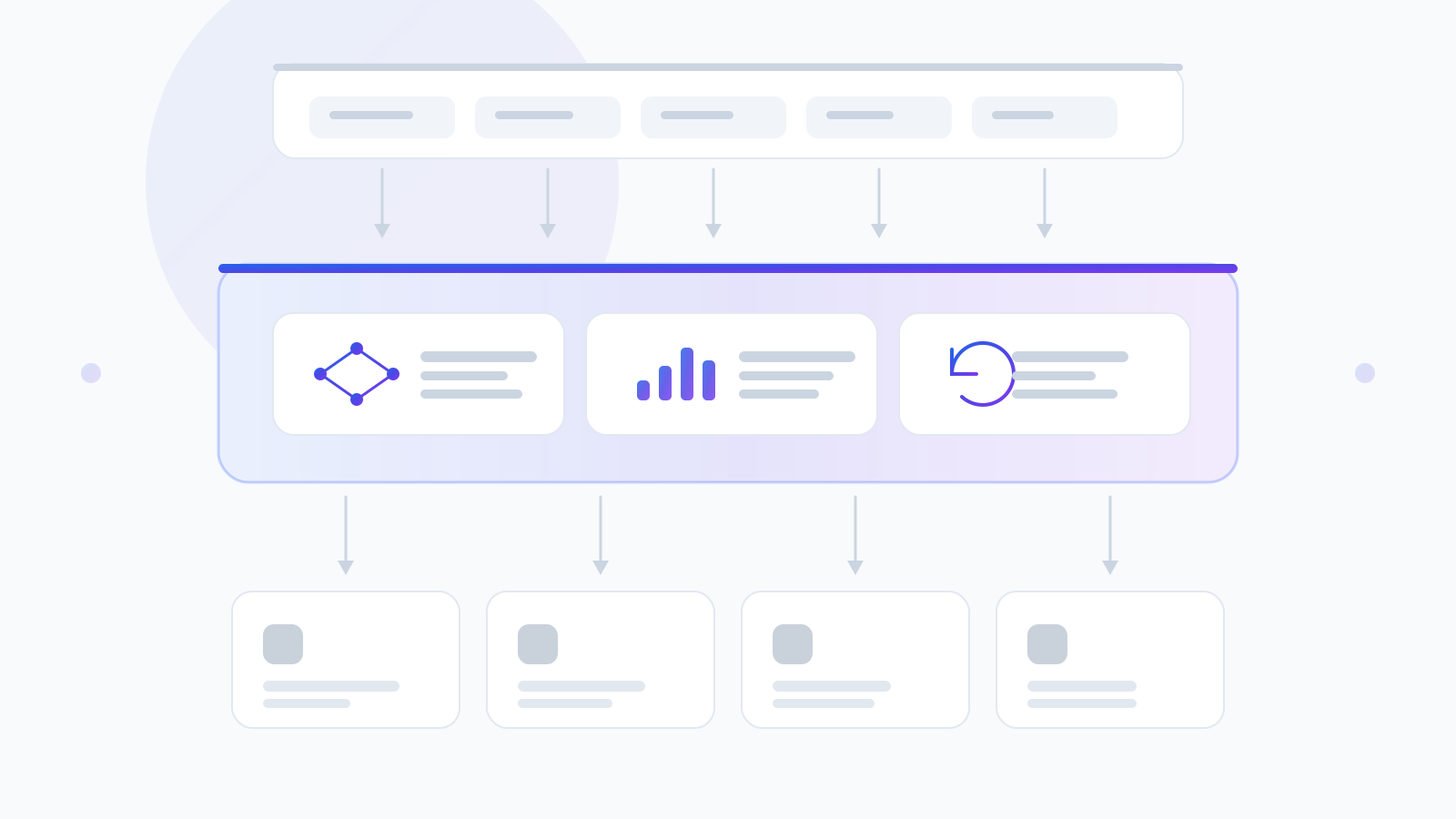
Aissist.io is an AI Operational Layer that sits on top of the help desk you already run — Intercom, Zendesk, Freshdesk, Kustomer, Front, Gorgias, eDesk, Salesforce and HubSpot among others — and resolves support and sales conversations end-to-end. Instead of a migration, its AgentMesh™ multi-agent workforce plugs into your existing stack, Pulse™ reads every conversation in real time, and Evolve™ keeps improving the operation. It's built on multi-agent reasoning with governance and human escalation, not a legacy FAQ chatbot.
The honest caveat: Help Scout is not currently a supported native integration, so this applies to teams already on — or moving to — one of the platforms above. Best for: teams whose real constraint is conversation volume rather than inbox ergonomics. Pricing: usage-based — $0.09 per AI interaction, capped at $0.20–$0.60 per resolution, depending on channel, with a free program covering 1,000 tickets a month on its free engine, which suits FAQs and simple procedures rather than the full agentic one. Pros: keep your current platform, deploys in about 10 minutes, resolves rather than deflects; Aissist reports 83% average resolution and 4.8/5 CSAT on automated support — vendor-reported figures, unlike the G2 ratings above. Cons: it's an automation layer, not a help desk — you keep a platform underneath it.
How to choose the right Help Scout alternative
Start with what actually broke.
Leaving because you need a phone channel? Hiver (voice add-on at $30/seat) or Gladly, both of which have native voice — Help Scout genuinely does not. Because of the Pro tier's 10-user minimum? HubSpot or Zoho Desk's Express tier, both $7 per user per month billed annually. Because reporting is too shallow? Zendesk or Freshdesk, where custom reporting isn't a two-tier upgrade. Because you want AI that closes conversations? Intercom's Fin at $0.99 per outcome, or Gorgias at $0.90 per resolved interaction — and note that Help Scout's own AI Answers at $0.75 per resolution is already the cheapest of the three, so check whether you actually need to move at all. Because you're ecommerce? Gorgias, clearly. Because you want to stay in Gmail? Hiver.
Then compare like tiers. Help Scout at $25 and Freshdesk at $19 aren't comparable if the features you need sit at Help Scout's $45 Plus tier and Freshdesk's $55 Pro. Add AI pricing explicitly — Fin from $0.99 per outcome, Gorgias $0.90 per resolved interaction, Help Scout $0.75 per resolution, Freddy Copilot $29 per agent — and only then look at the headline number.
Key takeaways
There is no single best Help Scout alternative — there's a best one for whatever pushed you to look. For collaboration, Front. For scale, Zendesk. For value, Zoho Desk or Freshdesk. For a phone channel, Hiver or Gladly. For ecommerce, Gorgias. For AI-first resolution, Intercom. For a CRM-attached desk, HubSpot. And keep the newer option in view: if the constraint is the volume of conversations your team has to handle personally rather than the inbox they handle it in, an agentic AI layer addresses that on whichever platform you land on. Shortlist two or three, pilot them on real conversations, and decide on resolution rate and true cost — not the entry price.
Keep your help desk, upgrade the resolution. Aissist.io adds an agentic AI layer to the major help desk platforms — resolving support and sales end-to-end, no migration required. Book a consultation →
Frequently asked questions
What are the best Help Scout alternatives?
The best Help Scout alternatives are Front, Zendesk, Freshdesk, Intercom, Hiver, Zoho Desk, Gorgias, HubSpot Service Hub and Gladly. Front is the closest like-for-like upgrade, HubSpot and Zoho Desk are the cheapest at $7 per user per month billed annually, Hiver keeps you inside Gmail, and Intercom is the most AI-native.
Why do teams switch away from Help Scout?
Four reasons dominate. There is no native phone channel — voice is "via integration" only. The Pro tier carries a 10-user minimum, creating a $750 monthly floor. Custom reporting and exports require the Plus tier at $45 per user. And the entry Standard tier limits routing to basic assignment, with round robin gated to Plus and above.
How much does Help Scout cost?
Help Scout has four tiers billed monthly, with roughly 16% off annually. Free covers 5 users, one inbox and one Docs site. Standard is $25 per user per month for up to 25 users. Plus is $45 for up to 50. Pro is $75 with unlimited users but a 10-user minimum. AI Answers is an add-on at $0.75 per resolution.
Does Help Scout have SLAs and CSAT?
Yes, both. SLA management runs one basic policy on Standard, two advanced policies on Plus, and unlimited on Pro. CSAT and NPS surveys are included from Standard upward, with satisfaction ratings built into email. Competitor comparisons sometimes list these as gaps — they aren't. The genuine gap is native phone support, which Help Scout does not offer.
Help Scout vs Zendesk — which is better?
Help Scout is simpler and faster to deploy; Zendesk is far more capable and considerably harder to run. Zendesk starts at $19 per agent per month against Help Scout's $25, but Zendesk's Suite tiers climb to $115. Below roughly 25 agents Help Scout usually wins on total cost of ownership. Past that, Zendesk's routing and reporting depth becomes hard to replicate.
Is there a free Help Scout alternative?
Yes. Zoho Desk's free plan covers 3 agents, and HubSpot Service Hub is free for 2 users — and among paid tiers both HubSpot and Zoho Desk's Express plan start at $7 per user per month billed annually. Help Scout's own free tier is more generous on seats at 5 users, though it limits you to one inbox, one Docs site, 10 saved replies and 100 contacts a month. For zero-budget teams on Google Workspace, a Google Groups Collaborative Inbox handles basic triage.
Does Help Scout have AI?
Yes, four distinct features. AI Answers resolves customer requests autonomously and is an add-on at $0.75 per resolution on the Standard, Plus and Pro tiers — it is not available on the free plan. AI Assist expands, shortens, edits and translates text, included from Standard. AI Drafts writes replies from past conversations, and AI Summarize condenses long threads — both included from Plus upward.
Which Help Scout alternative is best for ecommerce?
Gorgias. It is purpose-built for online retail, letting agents issue refunds, cancel orders and edit addresses inside the ticket, and it attributes revenue to support conversations. Pricing is per billable ticket rather than per seat, starting at $10 per month for 50 tickets, with AI at $0.90 per resolved interaction ($1.00 on Starter). Note that the Starter and Basic tiers cap at 3 agents.
Does Help Scout offer phone support?
Not natively. Help Scout's pricing comparison lists voice calling as available "via integration" on paid tiers, and its documentation covers routing voicemail notifications into an inbox as email with an audio attachment. Actual phone channels require a third-party tool such as Aircall, Talkdesk or JustCall. Hiver offers native voice as a $30 per seat add-on; Gladly includes it.
What happened to Groove as a Help Scout alternative?
Groove rebranded to Helply in June 2026 and changed its pricing model entirely — from per-seat to $1 per ticket, with a 250-ticket monthly minimum and a $3,000 annual floor, now targeting B2B SaaS. Groove Classic remains for legacy customers, but its seat pricing is no longer published, so older comparisons quoting a Groove per-user price are out of date.