Real-Time Agent Assist (2026): 8 Tools Compared, and Where AI Agent Assist Stops
By M.W., Co-founder · Published October 5, 2026 · Last updated October 21, 2026
AI agent assist, sold as real-time agent assist, feeds a human agent answers, prompts and summaries during a live conversation. It makes agents faster but never takes the ticket off their desk, and that ceiling decides what you should buy.
TL;DR: Real-time agent assist suggests and the human resolves; an AI agent resolves and the human gets the rest, so once AI owns tier 1 (Aissist reports 83% average resolution), cost per human ticket rises and assist must brief, not script.
Methodology & sources
- Eight contact-center tools from page-one results for "real time agent assist" plus adjacent QA vendors. Capabilities and prices from vendor pages, ratings from G2, all re-verified October 21, 2026.
- Productivity: NBER's Generative AI at Work (5,179 agents). Costs: Gartner's February 2024 benchmark. Practitioner evidence: Hacker News, October 15, 2026.
- Disclosure: this is Aissist's blog. Aissist sells an AI agent that resolves tickets and Agent Insight, which scores AI and human agents, so it is not ranked here and has a stake in the argument.
What is AI agent assist, and how is it different from an AI agent?
AI agent assist is software that suggests answers, next steps and summaries to a human during a live conversation; an AI agent talks to the customer itself and owns the resolution. The difference is not the model. It is who closes the ticket.
| Model | What the human still does | What the AI does | Who owns the resolution | What the metric becomes |
|---|---|---|---|---|
| Real-time agent assist | Reads each suggestion, replies, closes every ticket | Transcribes, retrieves answers, drafts replies, flags compliance | The human, every time | Handle time and after-call work |
| AI agent with structured handover | Takes escalations with a brief attached | Answers, runs lookups and actions, closes routine tickets | The AI on routine tickets; the human on escalations | Resolution rate and cost per resolution |
| Post-call QA and conversation intelligence | Coaches agents and fixes processes | Scores every interaction after it ends | Unchanged | QA score across AI and human agents |
Most definitions on page one stop at "use both." True, but the two models measure success in opposite units. Assist is judged by seconds saved per contact. An AI agent is judged by contacts a human never sees. Buy assist expecting the second result and you will get the first. QA, meanwhile, has moved fastest:
"We've gone from manually scoring 1-2% of our calls to using Level AI to score 100% of our calls!" — Angela Zander, Director of Operations, QuinStreet, via Level AI
The 8 best real-time agent assist tools in 2026
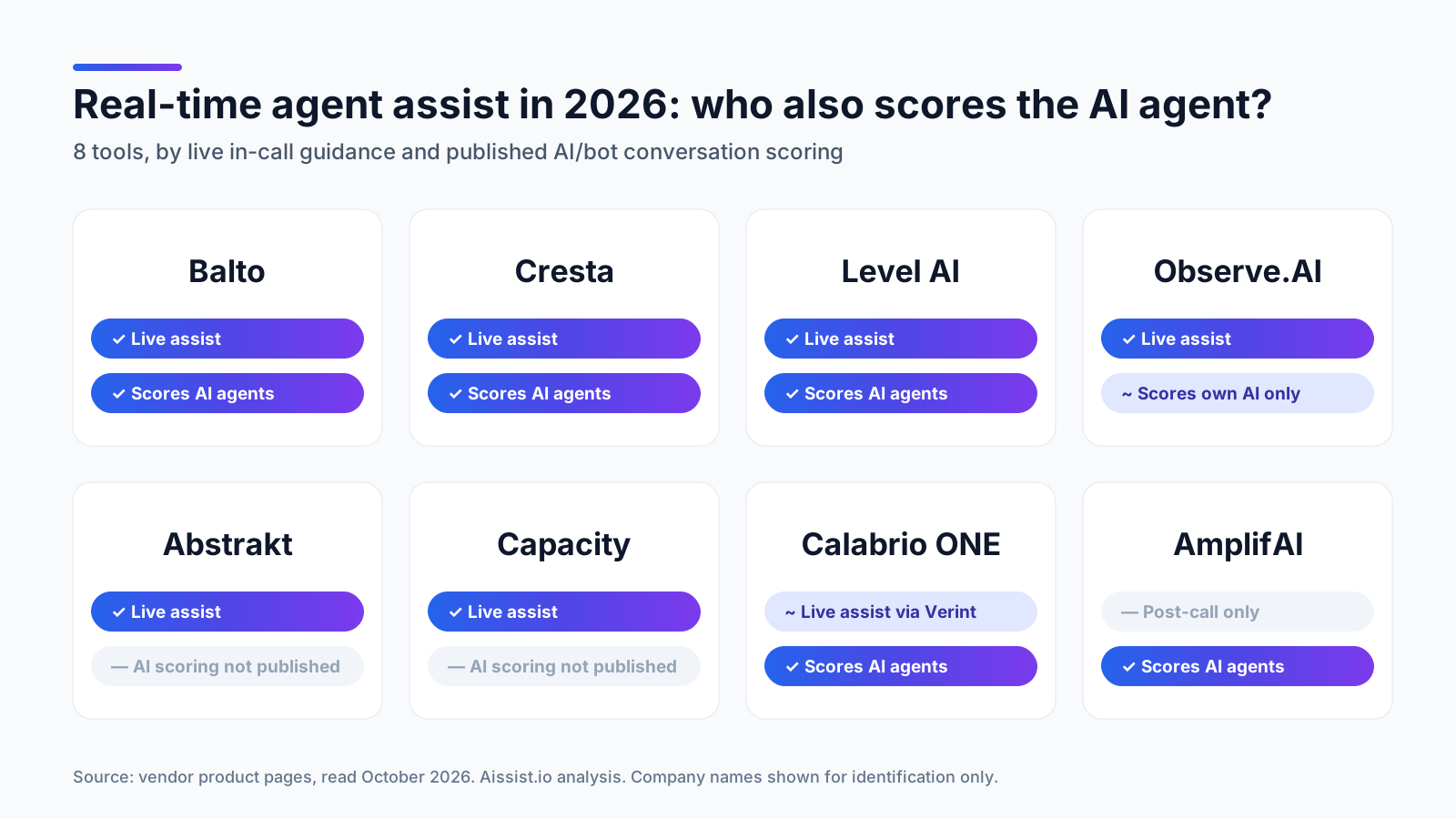
The strongest real-time agent assist tools in 2026 pair live guidance with scoring for AI agents; five of these eight now score AI conversations alongside humans.
- Balto — best for high-volume voice sales and service. Balto says it has guided 600M+ calls in real time.
- Cresta — best for enterprises that want assist, QA and AI agents from one vendor. Cresta credits it with cutting after-call work by 75% at Achieve.
- Level AI — best for Zendesk and Intercom teams running voice and chat. Its QA scores calls, chats, emails and bot conversations on one rubric.
- Observe.AI — best for regulated, voice-heavy enterprises. "AI Moments" such as negative sentiment trigger scripts and alerts mid-call.
- Abstrakt — best for SMB phone sales teams handling objections. Abstrakt says recommended responses trigger in 0.2 seconds.
- Capacity — best for mid-size voice centers wanting alerts plus self-service. A Peak Credit Union case study reports a 75% decrease in chatbot confusion.
- Calabrio ONE (now part of Verint) — best for existing Calabrio WFM shops. Its Bot Analytics measures bot experience and automation.
- AmplifAI — best for evaluating AI and human agents in one engine. It is post-call coaching, not live assist.
None of the eight publishes a price; "talk to sales" is the category's most consistent feature. The list also skews to the phone: four tools assist on voice calls only, and just Cresta and Level AI cover chat. Live assist was built for calls, where an agent cannot pause to search.
| Tool | Channels | Scores AI agents | Sells own AI agent | Price (Oct 2026) | G2 (Oct 2026) |
|---|---|---|---|---|---|
| Balto | Voice | Yes, same scorecards | Yes (Togo) | Not published | 4.8 (596) |
| Cresta | Voice, chat, email | Yes | Yes | Not published | 4.3 (46) |
| Level AI | Voice, chat | Yes, bot conversations | Yes | Not published | 4.6 (221) |
| Observe.AI | Voice | Its own voice AI | Yes | Not published | 4.6 (302) |
| Abstrakt | Voice | Not published | No | Not published | 4.7 (85) |
| Capacity | Voice | Not as a product | Yes | Not published; billed per agent hour | 4.7 (119) |
| Calabrio ONE | Via Verint coaching bots | Yes, Bot Analytics | Yes (Verint IVA) | Not published | 4.4 (444) |
| AmplifAI | Post-call only | Yes, one evaluation engine | No | Not published | 4.7 (21) |
Where does real-time agent assist hit its ceiling?
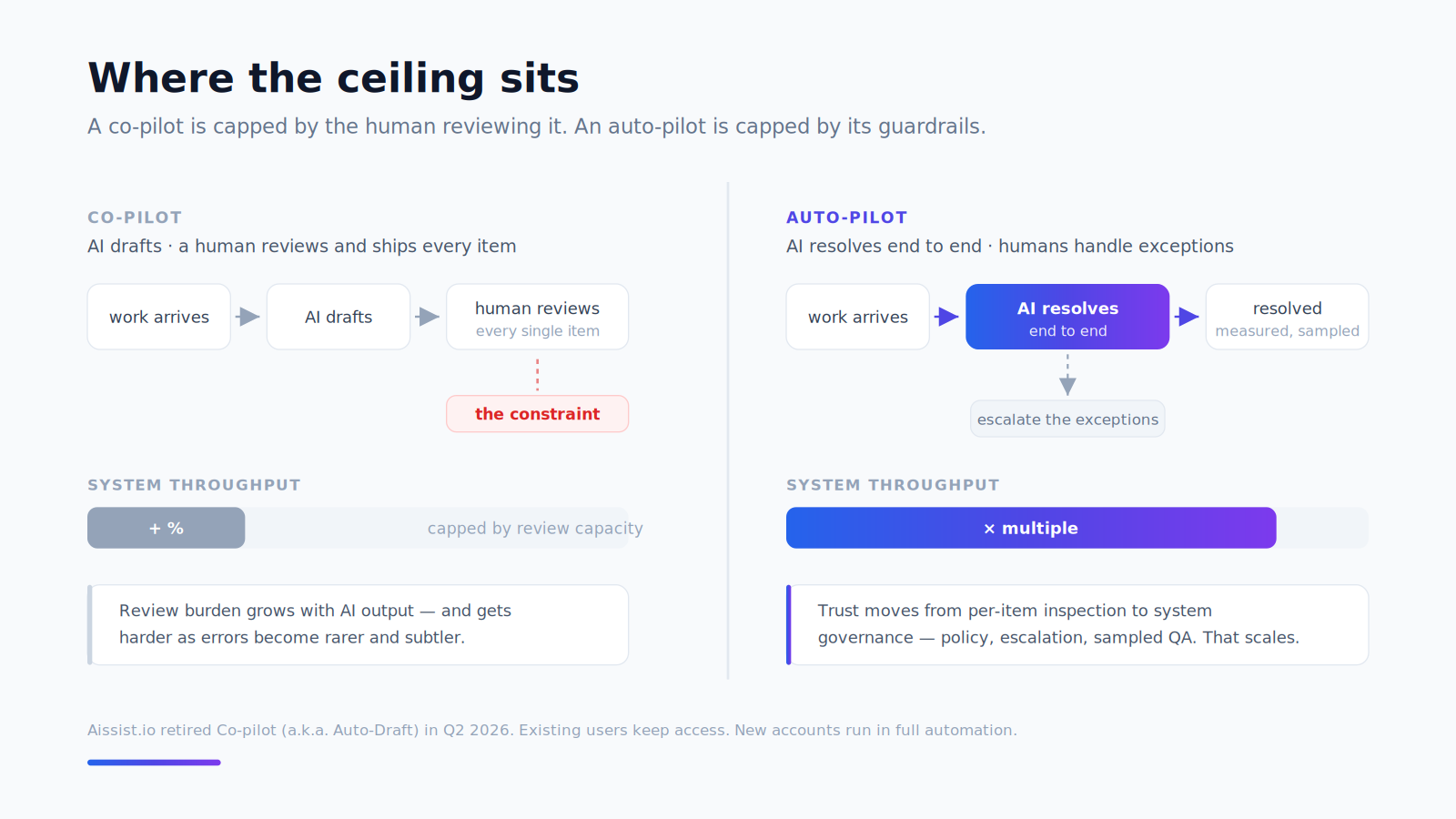
Real-time agent assist tops out at the speed of the human reviewing it: every suggestion still needs a person to read, judge and send it, and the gain shrinks as agents get more experienced. The NBER study Generative AI at Work found an AI assistant raised issues resolved per hour by 14% on average and 34% for novice workers, with minimal impact on experienced ones.
That is a real gain, and a training gain. It removes no contacts from the queue. 10,000 tickets in still means 10,000 human closes, just quicker ones.
Meanwhile, Gartner predicts that by 2029 agentic AI will autonomously resolve 80% of common customer service issues, cutting operational costs by 30%. The routine, novice-heavy queue assist was built for disappears first. It is hard to get faster at a ticket you no longer receive.
We made that call on our own product; see AI copilot vs autopilot.
"There's a lot of fear in AI and replacing jobs. The biggest piece is helping our internal teams understand that AI is an assistant — it's there to help you be better at your job." — Joshua Johnson, Senior Director of Operations Strategy, SoFi, via Observe.AI
Why does cost per ticket go up when an AI agent is working?
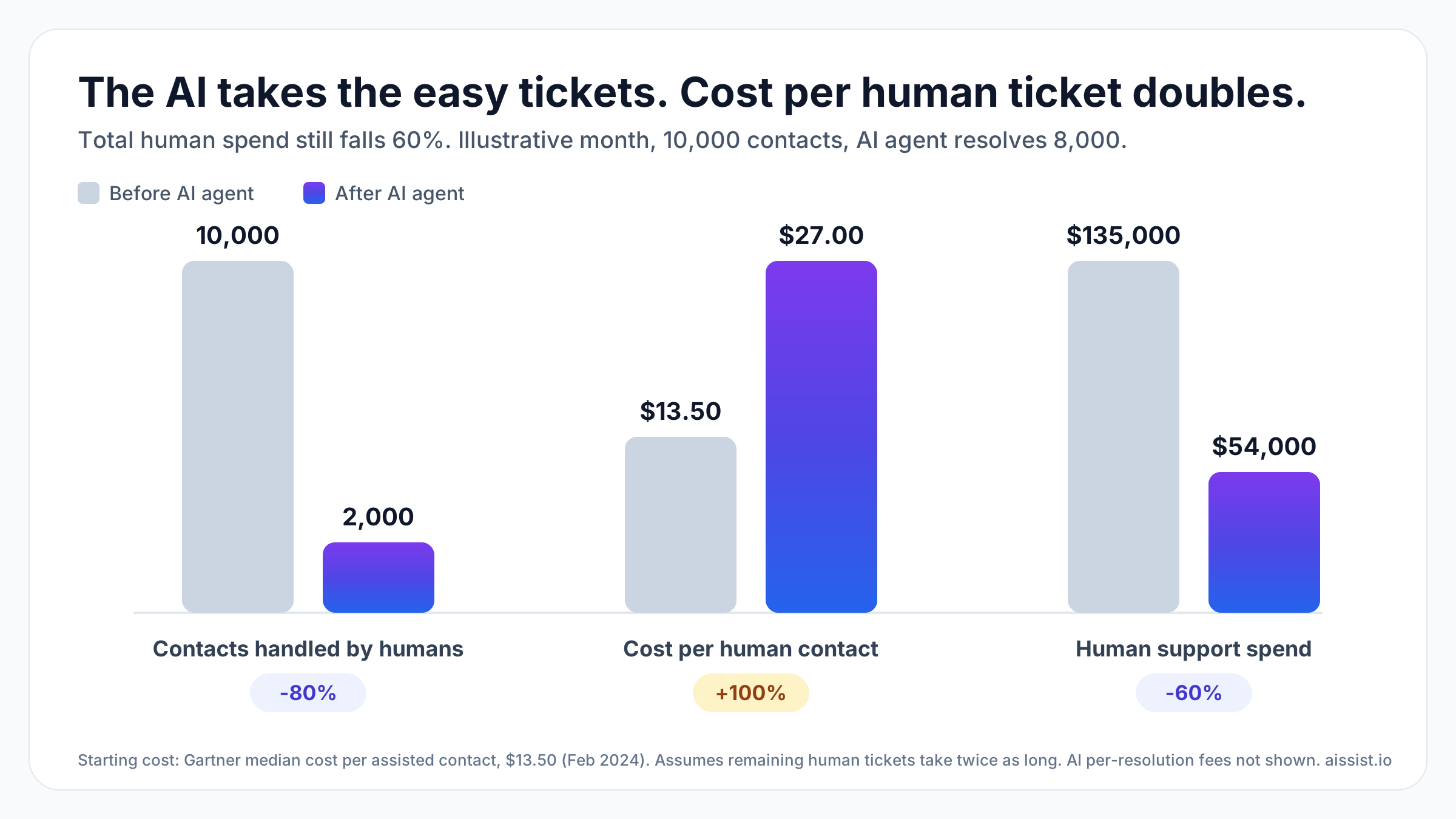
Cost per human ticket rises after an AI agent goes live because the AI takes the easy tickets and humans keep only the hard ones; the average looks worse while total spend falls. It is a mix shift, not a performance drop.
A commenter running support on a custom AI agent built on Amazon Bedrock described this split in a Hacker News thread on October 15, 2026: technically capable customers never see the 80–90% of inbound volume the AI answers from FAQs, so they only ever meet the edge cases.
"After putting in AI agents this year, our customer service scores went up considerably." — missedthecue, runs chat and email support, Hacker News
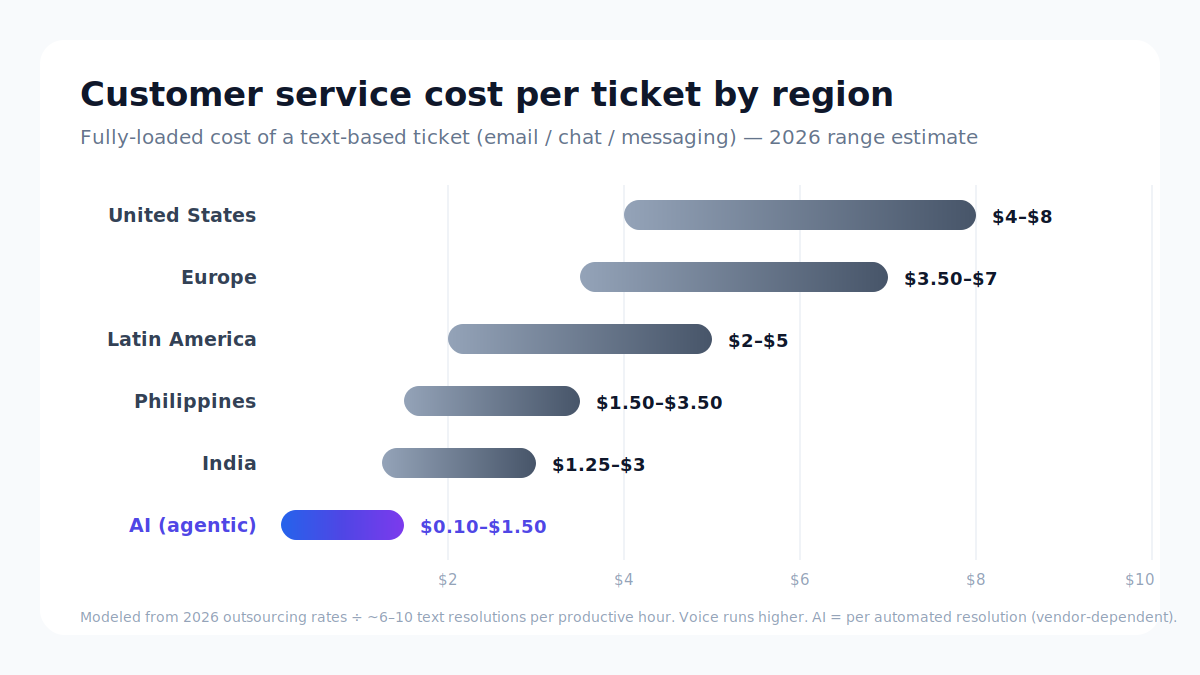
Here is the arithmetic, using Gartner's $13.50 median cost per assisted contact as the starting point:
| Illustrative month | Before AI agent | After AI agent |
|---|---|---|
| Contacts handled by humans | 10,000 | 2,000 |
| Cost per human contact | $13.50 | $27.00 |
| Human support spend | $135,000 | $54,000 |
Assumptions: the AI resolves 8,000 contacts and the 2,000 left take twice as long; add the AI's per-resolution fee for the 8,000. Judged by cost per human ticket, the project doubled costs. By cost per resolved ticket across AI and humans, it cut them by more than half.
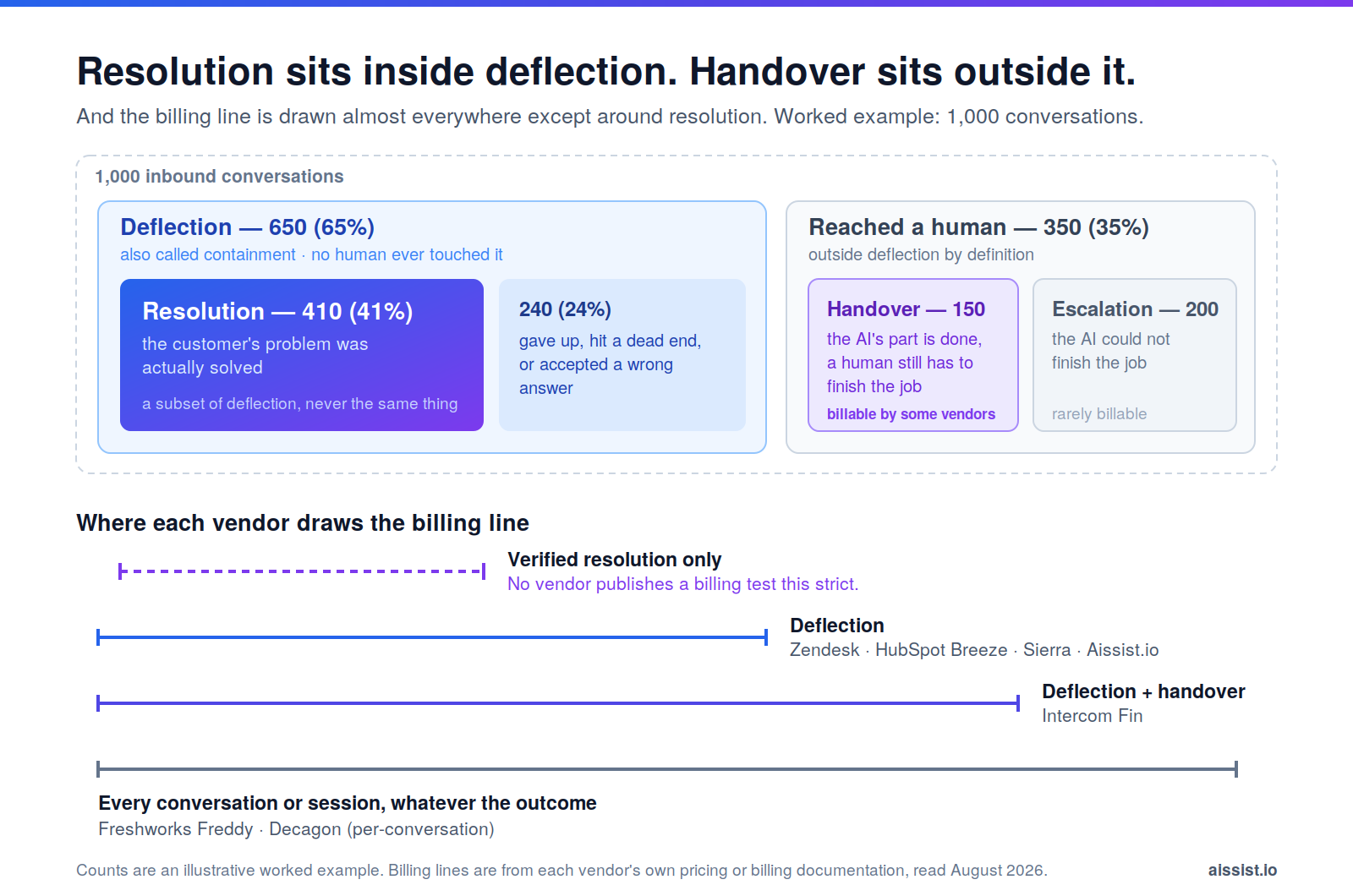
One condition: the 8,000 must be resolved, not deflected. A deflected ticket comes back as a reopen, which is the gap covered in deflection vs resolution rate.
What should agent assist hand a human on an AI escalation?
On an AI escalation, assist should hand the human a structured brief: who the customer is, what they want, what the AI tried, what it promised and why it stopped. A transcript dump is not a brief; it is homework.
| Field | Why the human needs it |
|---|---|
| Verified intent and identity | No re-authentication, no "can you repeat that" |
| Steps the AI already ran | No repeating checks the customer watched happen |
| Commitments made | No contradicting a refund or a deadline |
| Escalation reason | Policy limit, low confidence and customer request each need a different opening |
| Suggested next action, with source | The human verifies instead of starting from zero |
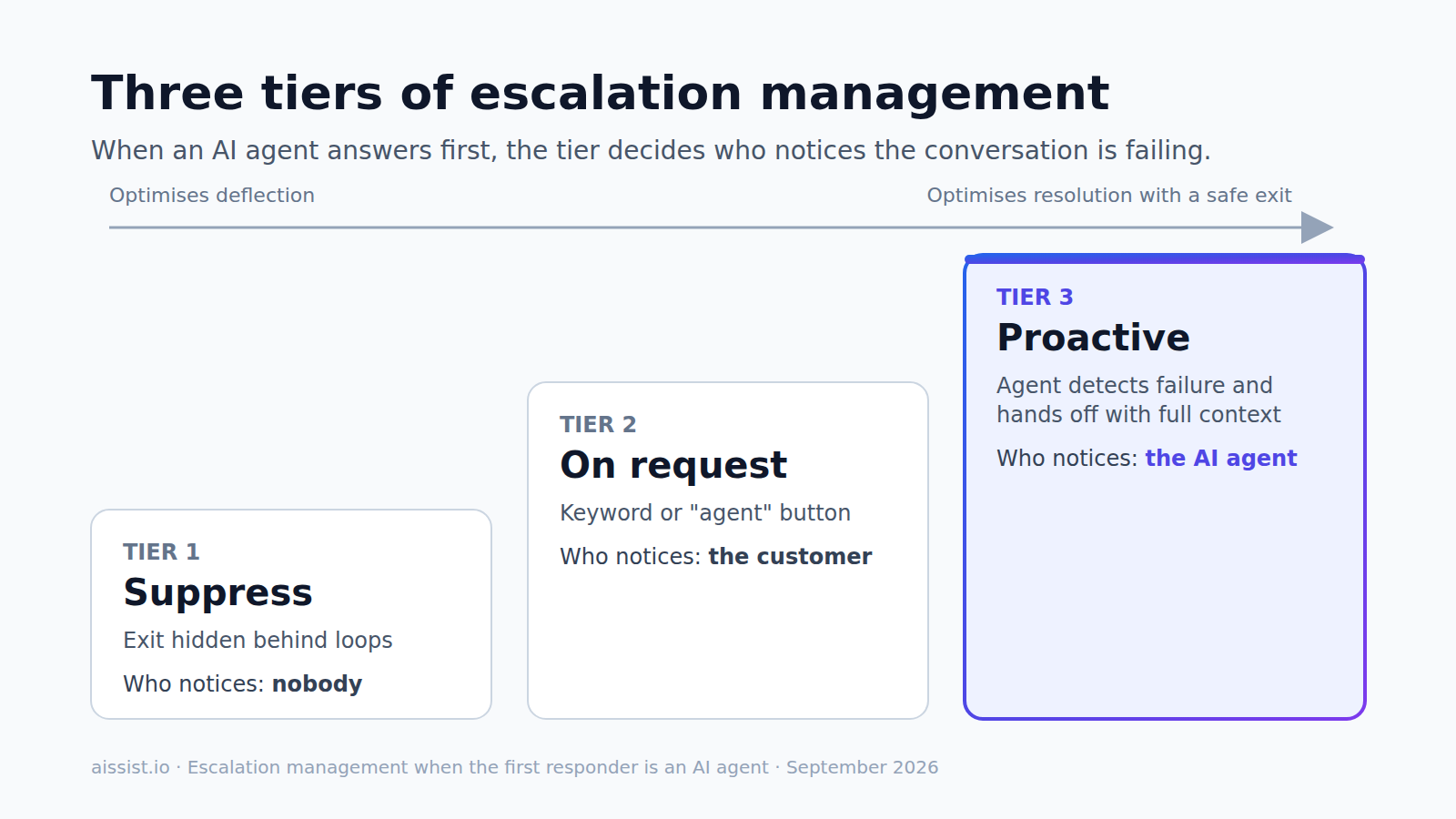
At Weltrade, escalated cases reach the backend team with complete context, a summarized issue and clear next steps, not a conversation to reread. Experienced escalation agents, the group NBER found assist helps least, need the brief, not suggestions. More in escalation management when an AI agent answers first.
"The auto-summarization has been huge, and it's not just the after-call work time that's the benefit. It really is that it allows agents to focus on the customers." — Dan Greer, SVP Servicing Operations, Aqua Finance, via Cresta
How do you choose real-time agent assist software?
Choose by who answers first in your queue, then by channel and stack.
- If humans still answer most contacts, pick on live-guidance quality and CCaaS fit (Balto, Abstrakt, Capacity), because classic assist gains are largest there.
- If an AI agent already handles tier 1, require a pre-escalation brief and AI-agent scoring (Cresta, Level AI), because your humans only see the hard cases.
- If most of your volume is chat and email, start with an AI agent that resolves, because text support has no mid-call time pressure for live assist to relieve.
- If your cost per ticket rose after launching an AI agent, check human spend and cost per resolution before blaming the AI, because the mix changed.
- If you want the AI to own resolution, compare an AI agent such as Aissist AgentMesh™, because assist is bought for a different outcome.
The verdict: assist makes agents faster; an AI agent takes tickets away
Real-time agent assist makes agents faster. It cannot shrink the queue, because the human still closes every ticket. Once an AI agent resolves most of tier 1, expect cost per human ticket to rise, judge on cost per resolution, and buy assist to brief experienced people on the hardest cases.
Frequently asked questions
What is AI agent assist?
AI agent assist is software that listens to a live call or chat and suggests answers, next steps and summaries to the human agent in real time. The human still decides, replies and closes the ticket.
What is the difference between agent assist and an AI agent?
Agent assist helps a human handle a conversation; an AI agent handles the conversation itself and escalates to a human when it cannot finish. Assist is measured in handle time, an AI agent in resolution rate.
Does real-time agent assist reduce after-call work?
Yes. Auto-summaries cut wrap-up most visibly: Cresta's customer stories report after-call work cut by 75% at Achieve and by 50% in collections at Aqua Finance.
How much does agent assist software cost?
None of the eight tools reviewed publishes a price as of October 2026; all are quote only. Capacity states it bills per hour of agent time.
Why did our cost per ticket go up after adding an AI agent?
Because the AI took the easy tickets and humans kept the hard ones, so each human ticket costs more while total spend falls. Track cost per resolved ticket across AI and humans instead.
Is real-time agent assist still needed if an AI agent handles tier 1?
Yes, for a different job: briefing experienced humans on escalations instead of scripting routine answers.
Changelog
- October 21, 2026 — Added the agent assist vs AI agent decision table, the ceiling and cost-per-ticket sections, and FAQ schema; re-verified all vendor facts and G2 counts.
- October 5, 2026 — First published.