Zendesk AI Review (2026): What It Costs, What "Resolved" Means, and Who It's For
Zendesk AI is the AI layer built into Zendesk's customer service suite — autonomous AI agents, a Copilot assistant for human agents, quality assurance and workforce management — and since 18 May 2026 it has billed on a system almost nobody outside Zendesk has explained correctly. Your AI budget is a dollar allowance, not a bundle of resolutions. A conversation becomes billable only when an LLM reviews the transcript at the end of a 72-hour window and decides the customer was satisfied. And the automation rate on your dashboard changed definition in the same release, so it went up without your invoice moving. This review covers what Zendesk AI does, what it really costs, where the evidence is thin, and who it fits.
TL;DR:
- What it is: The native AI layer inside the Zendesk suite. AI agents resolve autonomously; Copilot assists humans. You must own Zendesk to use it — with one exception, covered below.
- Best for: Teams already committed to Zendesk who want AI without adding a second platform, and who value compliance depth over per-unit price.
- Strongest capability: Governance and compliance. Zendesk holds ISO 42001 for AI management systems, which almost nobody else in this category does.
- Biggest friction: Cost predictability. Zendesk publishes no per-resolution rate, its own LLM decides what is billable, and overage is enabled by default.
- Not for: Teams not on Zendesk, teams that need to forecast AI spend precisely before signing, or teams whose main constraint is per-resolution price.
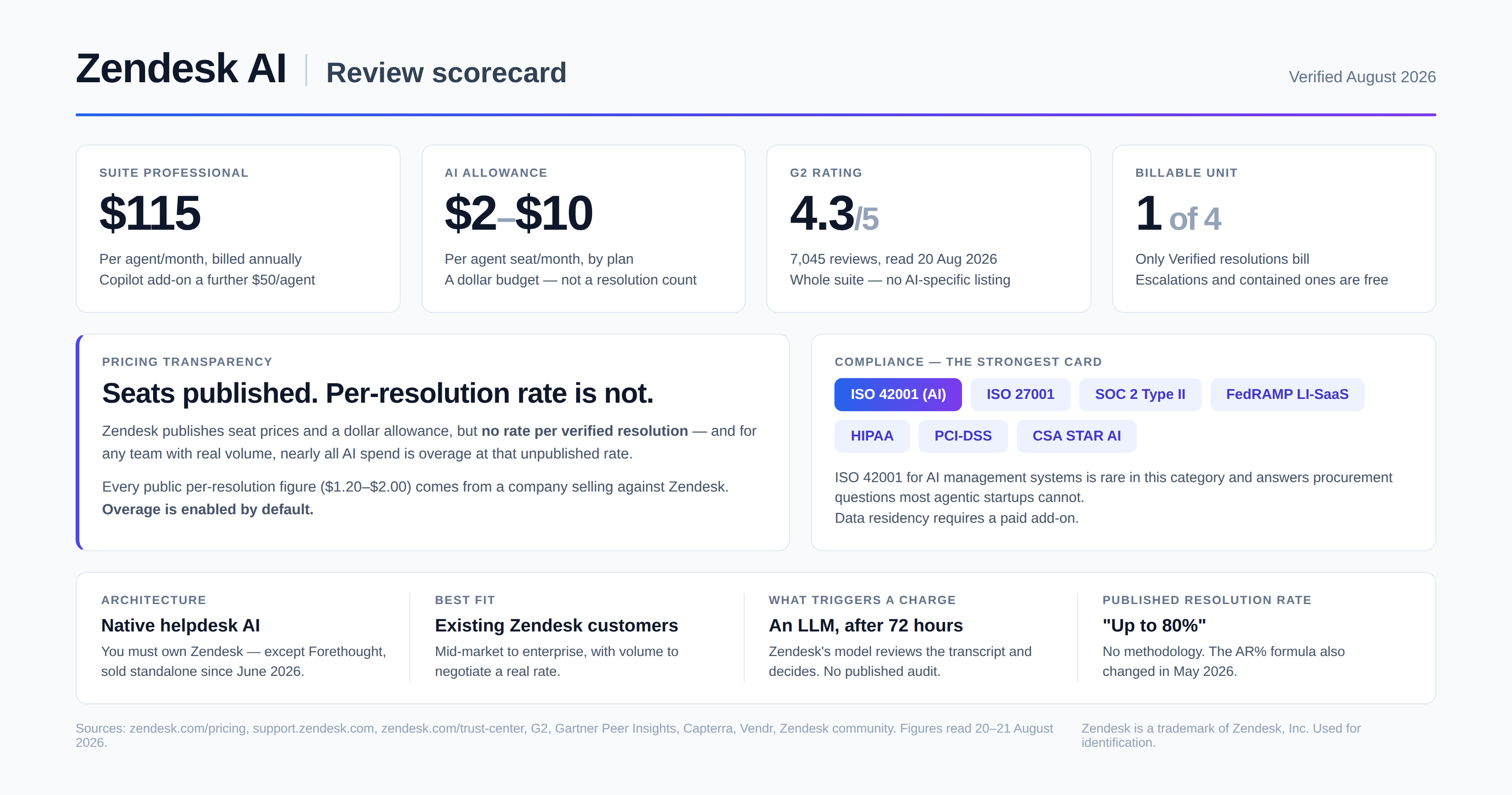
- Rating: 4.3/5 on G2 across 7,045 reviews — but that score covers the whole suite, not the AI. There is no AI-specific G2 listing.
One thing to fix in your head before reading any Zendesk AI pricing article, including this one: every per-resolution dollar figure circulating online comes from a company that sells against Zendesk, and they cite each other. Zendesk has published none of them. What Zendesk has published — and what this review is built on — is the allowance structure, and that turns out to be more useful anyway.
Reviewed by M.W., Co-founder. Disclosure: this review is published by Aissist.io, which sells an agentic AI layer that competes with Zendesk. Prices, ratings and definitions come from Zendesk's own pricing page, support documentation and trust center, plus G2, Gartner Peer Insights, Capterra, Vendr and the Zendesk community forums, all captured in August 2026.
How we evaluated Zendesk AI, and who wrote this
We build a competing product. Aissist.io sells an AI Operational Layer that resolves service and sales inside the helpdesk you already run — including Zendesk — so we are not neutral and you should not read us as neutral. Nearly every page ranking for "Zendesk AI pricing" is written by a Zendesk competitor, and almost none of them say so. We are saying so.
Three rules governed this piece:
- Zendesk's own documentation outranks everything. Where support.zendesk.com defines a term, we quote it verbatim and link it.
- Competitor claims about Zendesk are labelled as competitor claims — including every per-resolution price you will see quoted below, and including the fact that we are a competitor too.
- Where Zendesk contradicts itself, we show both statements rather than picking the one that flatters our argument.
We evaluated Zendesk AI on six criteria: what the AI can actually do, where it can run, cost transparency and predictability, evidence quality behind its performance claims, governance and compliance posture, and fit-to-segment. All figures were read on 20–21 August 2026.
Zendesk AI at a glance
| What it is | Native AI layer inside the Zendesk customer service suite |
| Components | AI agents (autonomous), Copilot (agent assist), Knowledge, Quality Assurance, Workforce Management, Forethought AI agents by Zendesk |
| Ownership | Private since November 2022 — Hellman & Friedman and Permira, ~$10.2B. CEO Tom Eggemeier |
| Architecture | Native to the suite. You must own Zendesk — except Forethought, which is sold standalone |
| Seat pricing | Support Team $19; Suite Team $55; Suite Professional $115 per agent/month billed annually. Suite Enterprise + Copilot: contact sales |
| AI add-on | Copilot $50 per agent/month billed annually |
| AI usage pricing | A dollar allowance of $2–$10 per agent seat/month by plan, drawn down by automated resolutions. No published per-resolution rate |
| Billable unit | Verified resolutions only. Contained resolutions and assisted escalations do not consume allowance |
| Channels | Messaging, email, voice, live chat, social |
| Languages | Zendesk states 80, 100+, 60+ and ~30 in different places — no single authoritative figure |
| G2 | 4.3/5, 7,045 reviews — whole suite, not AI-specific |
| Compliance | SOC 2 Type II, ISO 27001, ISO 42001 (AI), FedRAMP LI-SaaS, HIPAA, PCI-DSS |
| Best fit | Existing Zendesk customers, mid-market to enterprise, compliance-sensitive |
What is Zendesk AI?
Zendesk AI is the umbrella name for the artificial intelligence built into Zendesk's customer service platform, spanning autonomous AI agents that resolve customer conversations, a Copilot that assists human agents, and supporting tooling for knowledge, quality assurance and workforce management. It is not a separate product you can buy on its own — with one exception covered later — and it is not a bolt-on you install. It is the suite.
As of August 2026 the named components are:
- AI agents — the autonomous layer. These handle a customer conversation end to end, take actions through API integrations, and escalate to a human when they cannot finish.
- Copilot — agent assist, priced at $50 per agent/month annually. Its published components are intelligent classification, auto assist, admin copilot and analytics dashboards. Zendesk describes classification as automatically classifying "every request by topic, entity, sentiment, and language to power precise routing, automation, and reporting."
- Knowledge — article generation and knowledge management.
- Quality Assurance (QA) — conversation scoring, built from Zendesk's 2024 acquisition of Klaus.
- Workforce Management (WFM) — forecasting and scheduling, built from the 2023 Tymeshift acquisition.
- Forethought AI agents by Zendesk — from the March 2026 acquisition, and the only piece sold to non-Zendesk customers.
The naming has changed, and that is why you are confused
If you have evaluated Zendesk AI before, the vocabulary you learned is probably obsolete. Zendesk has renamed or restructured this product line repeatedly, and two changes in 2026 matter to buyers.
The "AI agents – Advanced" add-on no longer exists. Announced 30 March 2026 and rolled out between 11 May and 12 June, Zendesk eliminated the Essential and Advanced AI agent tiers and moved their capabilities — "agentic reasoning, multi-step procedures, and external API integrations" — into every Suite and Support plan. That is a genuine, unambiguous improvement: capabilities that used to cost extra are now included.
Legacy AI agents are being switched off. Announced 23 June 2026, Zendesk is removing AI agents – Essential and legacy AI agent functionality. Development ends 31 August 2026 and removal lands 10 December 2026. If you are running an older Answer Bot or Essential-tier configuration, you have a migration on your hands with a hard deadline.
One naming trap remains. Zendesk once used "Advanced" for two different things: the autonomous AI agent tier, and the Advanced AI add-on for agent assist. The autonomous one was folded into the base plans. The agent-assist one still costs $50 a seat and is now called Copilot. When a salesperson or an article tells you "Advanced AI is included now," ask which one they mean.
What changed in May 2026: the resolution tier system
This is the most consequential change to Zendesk AI in years, it is three months old, and it is the reason your reporting and your invoice no longer agree.
On 18 May 2026 Zendesk replaced its previous automated-resolution model with a four-category system. Zendesk's own documentation is the source for every definition below, quoted verbatim from the reporting change announcement:
| Category | Zendesk's definition | Billable? |
|---|---|---|
| Unassisted conversation | "The conversation triggered only small talk or system replies (not including successful Generative or Knowledge replies) and no automation was performed" | No |
| Assisted escalation | "The AI agent contributed to the interaction before a human agent completed the resolution" | No |
| Contained resolution | "A meaningful request is handled by the AI agent, without human involvement or follow-up" | No |
| Verified resolution | "A meaningful request is handled by the AI agent, with additional signals confirming the outcome was complete and satisfactory" | Yes |
Zendesk states the billing rule plainly: "You will continue to be billed only for Verified resolutions and Contained resolutions do not consume automated resolutions."
That is a genuinely buyer-friendly design, and it deserves credit. Under this model you do not pay when the AI collects information and hands off to a human. You do not pay when it exchanges pleasantries. You pay only when it finishes the job and the outcome checks out.
How a conversation becomes "verified" — the 72-hour rule
The mechanism is where it gets interesting. Zendesk evaluates a conversation at the end of what it calls the conversation session duration, "which is by default set to 72 hours after the first message." At that point, in Zendesk's words, "a verification process is performed by an LLM to evaluate the text of the conversation to ensure that the customer's request was actually satisfactorily resolved without human-agent intervention." Conversations that pass are billed. Conversations that "don't pass this verification are not considered verified and do not consume an automated resolution."
Two details are worth pinning down with your account team, because Zendesk's own pages word them inconsistently. The window is described variously as 72 hours from the first message and as 72 hours of inactivity, and the 72 hours is explicitly a configurable default rather than a fixed rule. Ask which applies to your account and whether it has been changed.
Two things follow, and buyers should hold both.
First, this is better than what it replaced. Under the older model, silence pushed a conversation toward being counted. Competitors built a whole critique around that — "silence counts as success," where a frustrated customer who abandons the chat looks identical to a satisfied one. Under the tier system, silence no longer bills you by itself; it opens a verification step that the conversation still has to pass. Any article still running the pure silence-equals-billing critique is describing a model Zendesk retired in May 2026.
Second, Zendesk grades its own homework. The LLM that decides whether a conversation was satisfactorily resolved is Zendesk's, and the invoice it produces is Zendesk's. We could find no published third-party audit of that evaluation model, no published accuracy rate, and no documented process for a customer to dispute a specific verification. We are a competitor and you should discount our framing accordingly — but the structural point stands regardless of who makes it, and it is a fair question to put to a Zendesk salesperson: who checks the checker, and what happens when I disagree?
The concern is not hypothetical to Zendesk's own customers. In Zendesk's community forum, a customer posting as Vinicius11 wrote that teams "might be getting charged for cases that aren't actual automated resolutions, but rather customer abandonments." That comment predates the tier system, which is precisely the sort of complaint the new verification step is designed to address — but it shows the failure mode buyers worry about is real to them.
Why your automation rate went up without your bill changing
Here is the trap. In the same 18 May release, Zendesk changed how the Automated Resolution rate (AR%) is calculated. The new formula, per Zendesk:
(Contained + Verified) / (Unassisted conversations + Assisted Escalations + Contained + Verified) × 100
Previously only Verified resolutions counted in the numerator. Now Contained resolutions count too. Zendesk says outright that customers "may notice an increase in your AR%."
So: the number on your dashboard now includes conversations you are not billed for. Your reported automation rate rose in May 2026 for reasons that have nothing to do with your AI performing better, and it is no longer the same metric as the one that generates your invoice.
Three practical consequences:
- Do not compare your AR% across May 2026. Pre- and post-change figures measure different things. Any internal trend line that crosses that date is broken.
- Do not benchmark against Zendesk's published case studies without checking dates. Zendesk's customer stories cite automation rates of 80% (Best Egg, TeamSystem, Action Property Management), 66% (Hello Sugar), 50%+ (Babbel) and 30–40% (Vimeo) — but the pages are not date-stamped, and a figure calculated before May 2026 is not comparable to one calculated after.
- Track Verified resolutions separately as your cost driver, and treat AR% as an engagement metric rather than a financial one.
Zendesk AI pricing: what's published and what isn't
Zendesk publishes seat prices and an allowance structure, but no per-resolution rate. The pricing page states only that "Zendesk AI agents are included in every Suite and Support plan, with pricing based on the successful outcomes they deliver," and that you "pay only for customer requests that were successfully resolved by the AI agent, without any escalation to a human agent."
Published seat prices, read 20 August 2026, billed annually:
| Plan | Price per agent/month |
|---|---|
| Support Team | $19 |
| Suite Team | $55 |
| Suite Professional (marked "Most Popular") | $115 |
| Suite Enterprise + Copilot | Contact sales |
| Copilot add-on | $50 |
| Workforce Engagement bundle | $50 |
| Contact Center | $83 |
The allowance is a dollar budget, not a resolution count
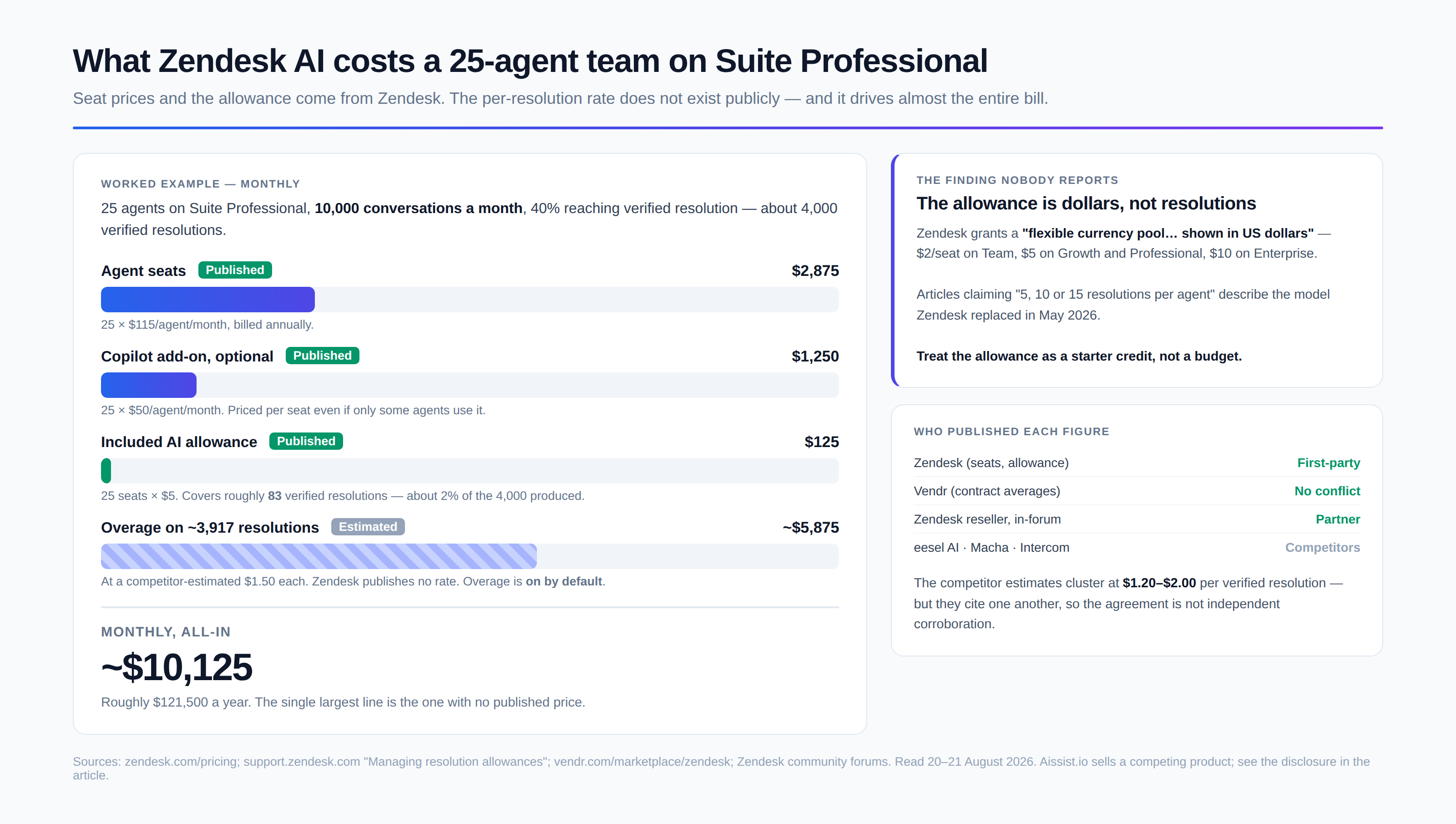
This is the finding that reframes the whole cost model, and we have not seen it reported anywhere else. Zendesk's resolution allowance documentation states: "Your resolution allowance is a flexible currency pool used to pay for the cost of automated resolutions," with a "total resolution budget, shown in US dollars."
The monthly allowance per agent seat, by plan:
| Plan | Zendesk Suite | Zendesk Support |
|---|---|---|
| Team | $2 per agent seat/month | $2 per agent seat/month |
| Growth | $5 per agent seat/month | — |
| Professional | $5 per agent seat/month | $2 per agent seat/month |
| Enterprise | $10 per agent seat/month | $2 per agent seat/month |
| Enterprise Plus | $10 per agent seat/month | — |
Several widely-circulated articles claim Zendesk bundles "5 / 10 / 15 verified resolutions per agent per month" and caps you at 10,000 a year. We could not find those figures in any current Zendesk document, and they are inconsistent with a dollar-denominated allowance. They most likely describe the pre-May-2026 model. Treat the per-seat resolution counts as superseded.
Zendesk also states you "can consume the balance freely across different resolution tiers without pre-selecting a fixed mix of tiers in advance." That phrasing sits awkwardly beside the statement that only Verified resolutions bill — if only one tier draws down the pool, there is no mix to select. Zendesk publishes no per-tier rate table, so whether the non-Verified tiers are genuinely free or merely cheaper is unresolved in the public documentation. Ask for a per-tier rate card in writing.
Overage is on by default
Worth knowing before your first invoice: when you exhaust the allowance, Zendesk's default is "Allow overage" — "Your account is charged for pay-as-you-go resolutions after you reach the limit." The alternative setting "pauses AI agent functionality when you reach your resolution allowance limit, preventing overage charges."
That is a real choice, not a formality. One setting risks an unexpected bill; the other risks your AI going dark mid-month. Neither is obviously right, and the default is the one that spends money. Decide deliberately.
What third parties claim a resolution costs
Read the conflict-of-interest column before the numbers.
| Reported rate | Publisher | Sells against Zendesk? |
|---|---|---|
| $1.20 committed / $1.50 overage per Verified resolution | eesel AI | Yes |
| ~$1.20–$1.50 committed; ~$2.00 pay-as-you-go | Intercom (Fin) | Yes — Fin is priced from $0.99 per outcome |
| ~$1.30–$1.50 committed; ~$2.00 overage, labelled a "third-party estimate" | Macha AI | Yes |
| €1.50 standard / €2.00 pay-as-you-go | A Zendesk reseller, in Zendesk's own community forum | No — partner, pro-Zendesk bias if any |
These figures are not independent of each other. Macha cites eesel and others; eesel cites further competitor teardowns and a Reddit thread. Trace them back and a handful of sources are recycling one another. The most credible entry in that table is the last one, because it comes from a Zendesk partner — a party with no incentive to inflate Zendesk's prices — writing inside Zendesk's own forum.
Taken together, a band of roughly $1.20–$2.00 per Verified resolution is plausible. It is not verified, and Zendesk has confirmed none of it.
For neutral contract-level data, procurement platform Vendr reports an average Zendesk contract value of $53,100 per year across 821 deals handled, with an average negotiated saving of 14.85% and a range from $8,509 to $267,622. Vendr notes that add-ons generally "can add 20–40% to the base subscription cost" — a figure covering the whole add-on catalogue, not AI specifically — and publishes no per-resolution rate.
A worked example
Take a 25-agent team on Suite Professional, handling 10,000 conversations a month.
Seats: 25 × $115 = $2,875/month, or $34,500 a year.
Copilot, if you add it: 25 × $50 = $1,250/month, another $15,000 a year. This is optional and many teams skip it.
Resolution allowance: 25 seats × $5 = $125/month. At a midpoint estimated rate of $1.50 per Verified resolution, that allowance covers roughly 83 verified resolutions a month.
That last number is the one to sit with. A team fielding 10,000 conversations a month that verifies even 40% of them autonomously is producing about 4,000 Verified resolutions — roughly 48 times what the bundled allowance covers. At an estimated $1.50 each, the overage on the remaining ~3,917 resolutions is about $5,875 a month, or $70,500 a year, on top of $34,500 in seats.
The allowance is not a meaningful AI budget. It is a starter credit. For any team with real automation volume, essentially all of your AI cost is overage, and overage is billed at a rate Zendesk does not publish. That, not the seat price, is what to negotiate.
Two caveats, stated plainly. The per-resolution rate in this model is a competitor-sourced estimate, so the total moves if your negotiated rate differs. And the arithmetic works in your favour if your automation rate is low — you pay only for what verifies, which is genuinely fairer than paying per conversation attempted. Our AI customer service benchmark covers how far claimed automation rates typically compress in production.
Where Zendesk AI runs — and the Forethought exception
Zendesk AI is native to the Zendesk suite. You cannot buy the AI agents and point them at Freshdesk or Intercom. If you are not a Zendesk customer, the AI is not available to you — with one significant exception.
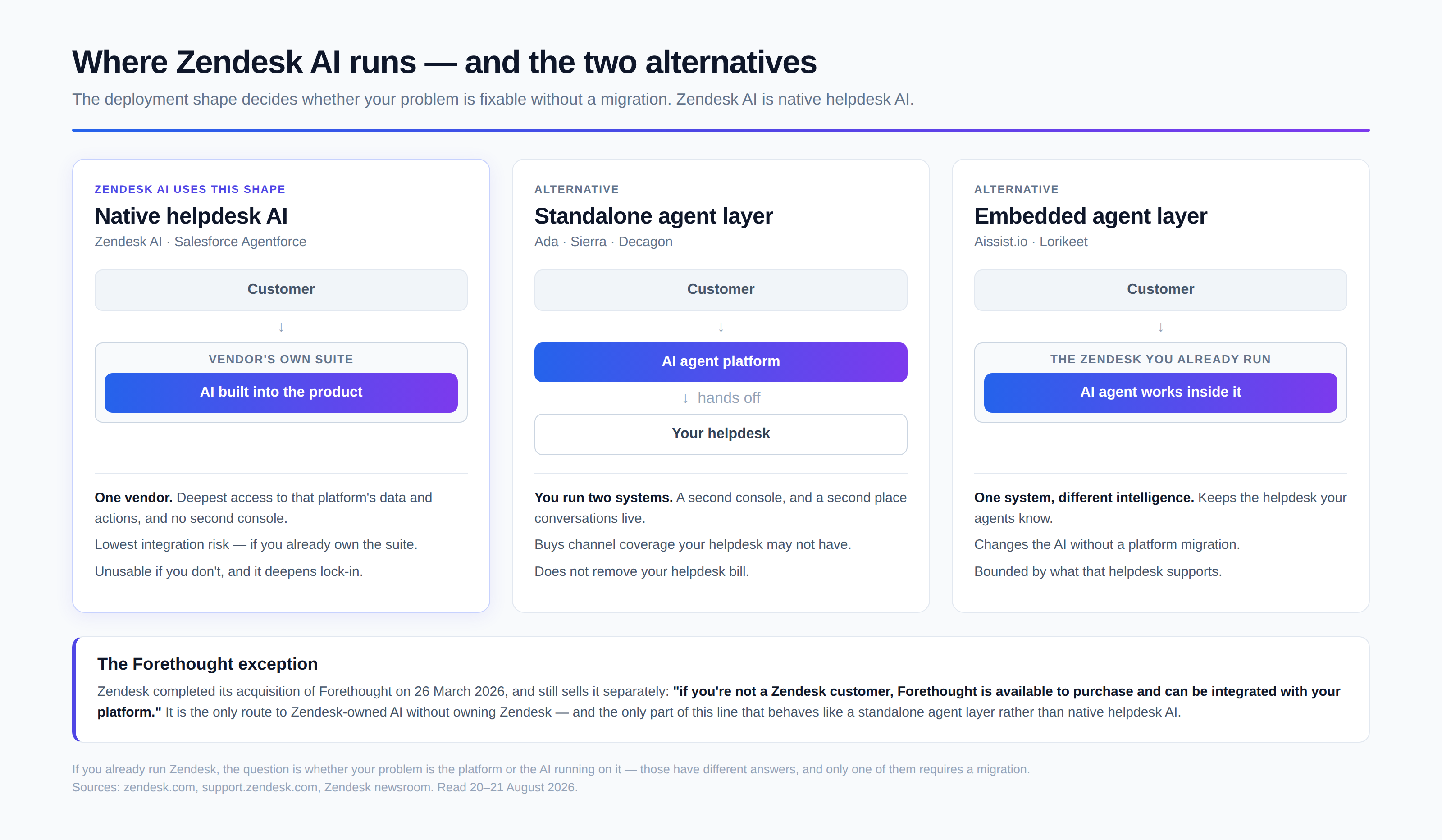
Forethought is the exception, and it is a real one. Zendesk completed its acquisition of Forethought on 26 March 2026, having announced it on 11 March. Terms were not disclosed. Crucially, Zendesk still sells it separately: in a June 2026 announcement, Zendesk states that "if you're not a Zendesk customer, Forethought is available to purchase and can be integrated with your platform and work across all supported channels."
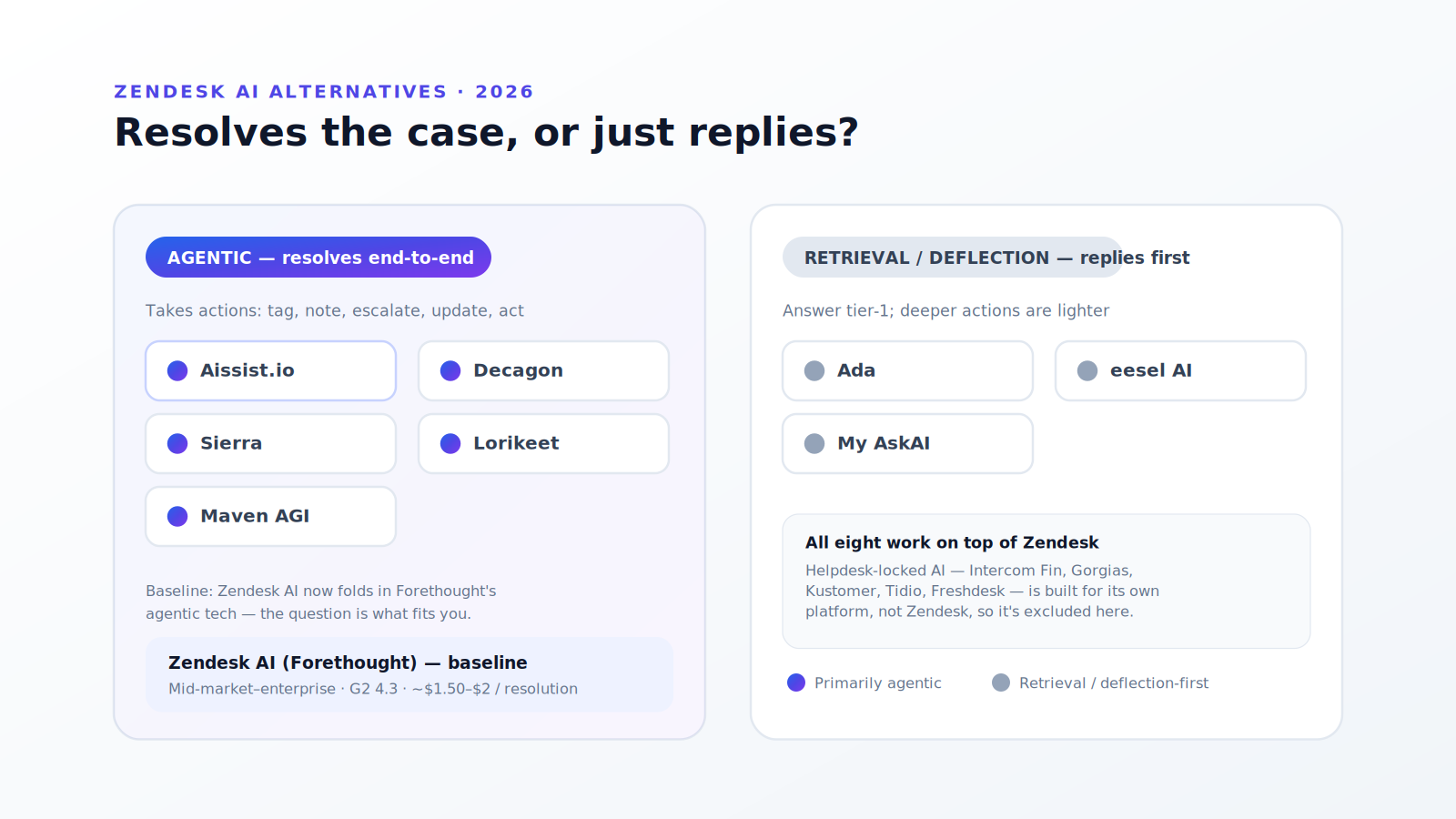
So the honest answer to "can I get Zendesk's AI without Zendesk?" is: not Zendesk AI, but yes, Forethought — which Zendesk now owns and markets as extending "beyond Zendesk into any other service environment." Pricing for it is not published. We cover the acquisition's fallout in more depth in our Forethought AI review and in what the Forethought acquisition means for Zendesk AI buyers.
There are three deployment shapes in this category, and the difference drives cost and effort more than any feature comparison:
- Native helpdesk AI — Zendesk AI, Salesforce Agentforce. Deepest access to that platform's own data and actions, lowest integration risk, and unusable unless you own the platform.
- Standalone agent layer — Ada, Sierra, Decagon. A second console alongside your helpdesk.
- Embedded agent layer — Aissist.io, Lorikeet. The agent works inside the helpdesk you already run.
If you are already on Zendesk and committed to staying, native is the lowest-friction path and Zendesk AI is a reasonable default. If you are on Zendesk but unhappy with the AI specifically, an embedded layer lets you add AI to Zendesk without replacing your stack — you keep the helpdesk and change only the AI. The choice turns on whether your problem is the platform or the intelligence running on it.
What Zendesk's AI agents can actually do
Channels. Messaging, email, voice, live chat and social. Voice AI agents reached general availability in Q2 2026 — a meaningful catch-up, since voice was a gap against Ada and Sierra for years. Employee-service AI agents entered early access in summer 2026.
Actions. Since the May–June 2026 consolidation, "agentic reasoning, multi-step procedures, and external API integrations" are included in every Suite and Support plan rather than gated behind an add-on. In practice this means the agents can look up orders, update records and trigger workflows through APIs, not just retrieve knowledge-base answers — the line that separates an agentic system from a generative one.
Languages — and here Zendesk contradicts itself four ways. Zendesk's AI agents marketing page claims "80 languages at native fluency." Its support documentation lists 100+ languages for use cases, generative replies and agentic AI, roughly 30 with auto-translated system replies, and 60+ with pronoun formality — without stating a total. Voice is advertised at "60+ languages," but that figure comes from an early-access announcement in which only ten are actually live — English, Portuguese, Spanish, German, French, Dutch, Italian, Polish, Romanian and Turkish — with the rest listed as coming soon. Zendesk adds its own caveat: "Additional languages outside of this list may also be supported, but we cannot guarantee that an AI agent will be fluent in them."
There is no single authoritative language count for Zendesk AI. If multilingual coverage is a requirement, get the supported list for your specific channels in writing rather than trusting any headline number, including the 80.
Performance claims and how much to trust them
Zendesk's headline claim, on its AI agents page, is "Deploy AI agents that resolve up to 80% of customer interactions." Elsewhere Zendesk phrases it as resolving "up to 80% of interactions autonomously across 80+ languages." Its Copilot page claims "82% increased agent productivity" and "5.5 hours saved by admins weekly." No methodology, sample size or date accompanies any of these figures.
The named case studies are more specific and therefore more useful: Best Egg reports an 80% automation rate on messaging and $500K+ in annual savings; TeamSystem 80% automation and a 99% reduction in repetitive emails; Fortnum & Mason a 90% drop in live chat processing time; Babbel 50%+ resolution; Vimeo 30–40%; Hello Sugar 66%. These are self-reported and unaudited, as case studies always are, but they name the company and the metric.
Two cautions specific to Zendesk, both stemming from the May 2026 change.
The case studies are undated. Because the AR% formula changed on 18 May 2026 to include Contained resolutions, an automation figure calculated before that date is not comparable to one calculated after. Zendesk does not date-stamp these pages, so you cannot tell which regime a given number belongs to.
"Automation rate" and "what you pay for" are now different metrics. A vendor quoting you 80% automation is quoting the broader number. Ask specifically what share of conversations reach Verified resolution, because that is the figure that generates the invoice.
At the company level, CEO Tom Eggemeier has told press that Zendesk runs "five billion automated resolutions a year," that AI ARR reached roughly $200M at the end of 2025 against total ARR near $2 billion, with trade press reporting that AI ARR "could reach up to $500 million in 2026, a 150 percent year-over-year jump". Those are executive statements in interviews, not audited figures — Zendesk has been private since 2022 and publishes no financials. Treat them as directional. For context on realistic outcomes across vendors, see our AI customer service benchmark.
Reviews and ratings: the suite score is not the AI score
| Source | Product listed | Score | Reviews |
|---|---|---|---|
| G2 | Zendesk for Customer Service | 4.3 / 5 | 7,045 |
| Gartner Peer Insights | Zendesk for customer service | 4.3 / 5 | 1,340 ratings |
| Capterra | Zendesk Suite | 4.4 / 5 | 4,090 |
| TrustRadius | Zendesk Suite | 8.5 / 10 | 1,088 |
| G2 | Forethought | — | 166 |
Every one of those scores rates the whole suite, not the AI. There is no distinct G2 listing for Zendesk AI agents; the closest AI-specific listing is Forethought's, at 166 reviews. This matters more than it sounds. A 4.3 built over a decade of ticketing reviews is routinely cited as evidence for an AI product that shipped in the last eighteen months. It is not evidence for that at all, and no other page we found makes this separation.
On its own terms the suite rating is solid and hard-earned. Reviewers consistently praise ease of use, the centralized omnichannel inbox, ticket organization and the integration ecosystem.
The complaints are equally consistent, and two of the three loudest are about commercial structure rather than capability: limited customization, a steep learning curve, and high per-agent pricing with à-la-carte add-ons. Capterra's sub-scores make the point precisely — ease of use 4.5, features 4.4, customer service 4.3, and value for money 4.2, the lowest of the four.
Verbatim, from G2 reviewers:
"I dislike that everything is an add-on. You have to purchase everything individually and it can get quite pricy." — Lisa M., Customer Experience Content Team Manager
"Zendesk's pricing can be a little frustrating as many services are ala-carte. In addition, many require a 'per agent' fee." — Aja V., CX Operations Consultant & Zendesk Strategist
On the AI itself, sentiment splits. One G2 reviewer, Sabina K., IT Operations Manager, credits it directly: "Zendesk AI is able to propose answers to agents on similar tickets that have been previously dealt with." A TrustRadius reviewer pushes the other way — "Less AI! We do not use AI and ZD has been pushing LOTS of it" — and TrustRadius's own feature summary lists "limited AI features requiring manual approval for responses."
One gap worth naming: the review corpus has not caught up to the tier system. We found no review-platform complaints specifically about resolution-tier billing, which is unsurprising three months after launch. Absence of complaints here is not evidence of absence of problems — the reviews simply predate the change.
Zendesk's own community forum is more current, and less comfortable reading. In the AI agents launch thread, a customer posting as Adam14 writes that "at $1.50–$2 each, we're talking $7,500 to $10,000/month, just for automated resolutions" and that "it seems like a massive bait-and-switch." A second commenter, Vinicius11, contrasts that with competing tools "charging around $700/month flat, regardless of volume." In a separate June 2026 thread, an EMEA Zendesk reseller posting as Sini11 reported that managed accounts cannot see their AI Agent Allowance usage in Admin Center at all — so customers cannot track consumption, know when to buy more, or tell which rate they are on. Five users backed the thread. At the time of writing it has no response, from Zendesk or anyone else.
We flag that one specifically because it is the most checkable risk on this page: verify in a trial that you can actually see your own allowance consumption before you sign.
Security and compliance — Zendesk's strongest card
This section is where Zendesk clearly beats the agentic-AI startups it competes with, and we would rather say so than pretend otherwise.
Per Zendesk's trust center, the certifications include SOC 2 Type II; ISO 27001:2022, 27017, 27018 and 27701; ISO 42001, the AI management systems standard; CSA STAR AI Levels 1 and 2; FedRAMP LI-SaaS; PCI-DSS; HIPAA with a BAA; HDS 1.1 for French health data; Cyber Essentials Plus; ISMAP for Japan; and EU-approved Binding Corporate Rules.
ISO 42001 and CSA STAR AI are the notable entries. Very few vendors in AI customer service hold an AI-specific management-system certification. If your procurement process has started asking AI governance questions — and in regulated industries it has — Zendesk can answer them with paperwork most of this category cannot produce.
Two qualifications. FedRAMP authorization is at LI-SaaS (Low Impact), not Moderate, which constrains US federal use cases. And data residency across the US, EEA and Asia Pacific requires the paid Data Center Location add-on — it is not included.
On AI training data, read the nuance carefully. Zendesk states that "Zendesk customer data will never be used by the third-party LLM provider to train their model(s)," which is a strong and welcome commitment covering providers such as OpenAI. But Zendesk does use service data to train its own models: "Before Service Data is used to train generic ML functionality, Zendesk applies aggregation and sanitation processes," with identifier fields excluded and a commitment that "no Service Data will be reproduced by the model." Zendesk notes its proprietary models "are not generative in nature."
That is a defensible position, and more transparent than most. But "we don't train on your data" is not quite what the policy says, and we could not find a documented customer opt-out from the first-party training. If that matters to you, ask for it in contract language.
Pros and cons
Pros
- Only Verified resolutions bill. Assisted escalations and contained resolutions are free — a fairer unit than paying per conversation attempted, and better than several competitors' models.
- Agentic capabilities are now included, not an add-on. Multi-step procedures and API integrations moved into every Suite and Support plan in mid-2026.
- Best-in-category compliance posture — ISO 42001 for AI management, ISO 27001, SOC 2 Type II, FedRAMP LI-SaaS, HIPAA and PCI-DSS.
- Deepest possible integration if you already run Zendesk. No second console, no parallel workflow, no data-sync layer.
- A real off-platform option via Forethought, which Zendesk still sells to non-Zendesk customers.
- Overage can be capped — the setting that pauses AI at the allowance limit does prevent surprise bills.
- Mature, well-reviewed platform underneath: 4.3/5 across 7,045 G2 reviews and 1,340 Gartner ratings.
Cons
- No published per-resolution rate. The single most important number in the cost model is negotiated privately, and every public figure comes from a competitor.
- The bundled allowance is negligible — $2–$10 per seat/month, covering roughly 1–7 verified resolutions per agent at estimated rates. Nearly all real spend is overage.
- Zendesk's LLM decides what is billable, with no published audit, accuracy rate, or documented dispute process.
- Reporting and billing metrics diverged in May 2026. AR% now includes unbilled contained resolutions, so the headline number rose without performance improving.
- Allowance visibility is unreliable — a Zendesk reseller publicly reported managed accounts cannot see usage in Admin Center, with no response from Zendesk.
- Overage is enabled by default, and the alternative pauses your AI agents.
- Add-on sprawl is the most consistent reviewer complaint; Capterra's lowest sub-score is value for money.
- No AI-specific review data. The 4.3 rating is a suite score being used to vouch for a much newer AI product.
- Language claims contradict across four Zendesk sources, ranging from ~30 to 100+.
- Legacy AI agents are removed on 10 December 2026, forcing a migration on older configurations.
Who Zendesk AI is for, and who it isn't
Zendesk AI is a good fit if: you already run Zendesk and intend to keep it; you are mid-market or enterprise with the volume to negotiate a real per-resolution rate rather than accepting list; compliance is a gating factor in your buying process and ISO 42001 or FedRAMP matters; you want AI without adding a second platform, console or vendor relationship; and you value a fair billable unit — paying only for verified outcomes — over the lowest per-unit price.
Zendesk AI is a poor fit if: you are not a Zendesk customer, in which case only Forethought is available to you; you need to forecast AI spend precisely before signing, since the rate that determines nearly all of your cost is unpublished; per-resolution price is your primary constraint, where competitors publish rates below the estimated Zendesk band; you are a small team where the per-agent seat cost plus Copilot plus overage compounds badly; or your knowledge and workflows live largely outside Zendesk.
The sharper question, if you are already on Zendesk: is your problem the platform or the AI running on it? Those have different answers. If Zendesk's ticketing, routing and reporting work for your team and only the AI disappoints, replacing the whole suite is an expensive way to fix a narrow problem — an embedded agent layer that works inside Zendesk changes the intelligence while keeping everything your agents already know. If the suite itself is the constraint, that is a platform decision, and our Zendesk alternatives and Zendesk competitors guides cover the field.
Keep Zendesk. Change the AI. Aissist.io deploys inside the Zendesk you already run and resolves service and sales end-to-end — transparent per-resolution pricing, no second console, no migration. See how we compare with Zendesk AI or book a demo.
Frequently asked questions
What is Zendesk AI?
Zendesk AI is the artificial intelligence layer built into Zendesk's customer service suite. It includes autonomous AI agents that resolve customer conversations end to end, Copilot for assisting human agents, plus Knowledge, Quality Assurance and Workforce Management. It is native to Zendesk — you generally need a Zendesk subscription to use it, except for Forethought, which Zendesk sells separately.
What counts as an automated resolution in Zendesk?
Since 18 May 2026, Zendesk sorts conversations into four categories and bills only for Verified resolutions — where "a meaningful request is handled by the AI agent, with additional signals confirming the outcome was complete and satisfactory." Unassisted conversations, assisted escalations and contained resolutions do not consume your allowance. Sandbox and Admin Center testing are also excluded.
What is the difference between a contained resolution and a verified resolution?
Both mean the AI handled the request without a human. The difference is verification: after 72 hours with no customer follow-up, a Zendesk LLM reviews the transcript to judge whether the request was satisfactorily resolved. Conversations that pass become Verified resolutions and are billed; those that fail are logged as Contained resolutions and are free.
What is Zendesk's 72-hour rule?
The 72-hour window is the period of customer silence that triggers Zendesk's verification check — not, as is often reported, an automatic billing event. After 72 hours with no follow-up, an LLM evaluates the conversation text to confirm the request was resolved. Only conversations that pass that check are billed. Older articles describing silence as automatically billable are describing the model Zendesk retired in May 2026.
How much does Zendesk AI cost per resolution?
Zendesk does not publish a per-resolution rate. Third-party estimates cluster around $1.20–$1.50 per verified resolution on a committed plan and about $2.00 pay-as-you-go, but every published figure comes from a company selling against Zendesk, and those sources cite one another. A Zendesk reseller in Zendesk's own forum quoted €1.50 standard and €2.00 pay-as-you-go. Treat the band as plausible, not confirmed.
How many automated resolutions are included in my Zendesk plan?
Zendesk does not bundle a number of resolutions — it grants a dollar allowance. That is $2 per agent seat/month on Team, $5 on Growth and Professional, and $10 on Enterprise and Enterprise Plus for Zendesk Suite. Claims of "5, 10 or 15 resolutions per agent" describe the older model and appear superseded. At estimated rates, $5 covers roughly three verified resolutions per agent per month.
What happens if I exceed my Zendesk resolution allowance?
By default, overage is allowed and your account is billed pay-as-you-go for resolutions beyond the limit. You can change the setting to "Don't allow overage," which prevents extra charges but pauses AI agent functionality once the allowance is exhausted. Overage being on by default is worth checking before your first billing cycle.
Is Zendesk Copilot worth $50 per agent per month?
It depends on how many agents genuinely need it. Copilot provides intelligent classification, auto assist and admin copilot, and Zendesk claims an 82% productivity increase without publishing a methodology. Because it is priced per seat, teams where only a minority of agents would use it — a common complaint in Zendesk's community forum — face buying it for everyone. Some ticket-summary and admin-copilot features are now free on Professional plans and above, with usage caps.
Is Zendesk AI worth it in 2026?
For teams already on Zendesk, generally yes — the billable unit is fair, agentic capabilities are now included rather than an add-on, and the compliance posture is the strongest in the category. It is poor value if you are not on Zendesk, if you need predictable AI spend before signing, or if per-resolution price is your main constraint, since competitors publish rates below the estimated Zendesk band.
What did the Forethought acquisition mean for Zendesk AI?
Zendesk completed its acquisition of Forethought on 26 March 2026 for undisclosed terms, describing it as accelerating the roadmap for self-improving AI agents across chat, email and voice. For buyers, the practical effect is that Forethought remains purchasable standalone and can run on non-Zendesk platforms — making it the only route to Zendesk-owned AI without owning Zendesk.
Does Zendesk train its AI on my data?
Partly. Zendesk states that third-party LLM providers such as OpenAI never use Zendesk customer data to train their models. However, Zendesk does use service data to train its own machine learning, applying "aggregation and sanitation processes" and excluding identifier fields such as usernames and email addresses. Zendesk notes its proprietary models are not generative. We found no documented customer opt-out from that first-party training.
Changelog
- August 2026 — First published. All prices, ratings and definitions read 20–21 August 2026. Documented the May 2026 resolution tier system and the four billing categories from Zendesk's own documentation. Established that the resolution allowance is a dollar budget ($2–$10 per agent seat/month), not a bundled resolution count — correcting the "5/10/15 resolutions per agent" figures repeated widely elsewhere. Noted that the Automated Resolution rate formula changed on 18 May 2026 to include unbilled contained resolutions, making pre- and post-change automation figures non-comparable.